

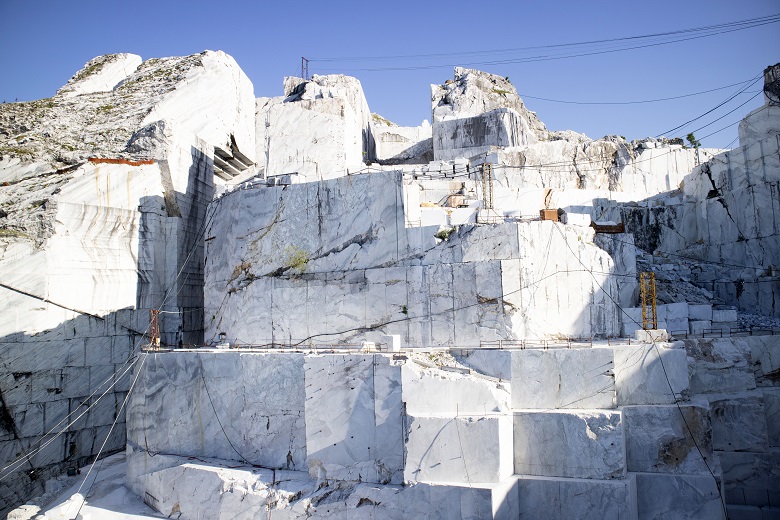



The city of white gold has officially added a new prestigious title to its millenary history. The Tuscany Region has designated Carrara as the first “Tuscany Capital of Contemporary Art 2026.” This recognition celebrates a city that, as its candidacy dossier suggests, has been “contemporary for 2,000 years,” driven by its unique relationship with its most precious resource: Apuan marble.
Beyond Extraction: Marble as a Living Medium
While Carrara is globally recognized as the epicenter of marble quarrying and processing, this new title shifts the spotlight toward the artistic soul of the material. The designation follows Carrara’s impressive run as a finalist for the Italian Capital of Contemporary Art, highlighting how the city has successfully bridged the gap between its industrial heritage and avant-garde expression.


For Carrara, marble is not just a commodity; it is a language. From the Roman era to Michelangelo, and now to the digital age, the white stone of the Apuan Alps continues to attract creators from across the globe. Today, the city’s identity is defined by a vibrant ecosystem where historic artisan workshops (laboratori) and the Academy of Fine Arts collaborate with international designers and contemporary sculptors.
A Hub for Innovation and Design
The regional recognition aims to strengthen the “Contemporary Art Supply Chain,” viewing marble processing as a sophisticated blend of ancient craftsmanship and modern technology. Major events like White Carrara—which in its 2024 edition focused on “Design is Back”—demonstrate how marble is being reimagined for 21st-century architecture and luxury design.
“Carrara’s strength lies in the transmission of knowledge,” noted regional authorities during the announcement. The city serves as an “open-air gallery” where the landscape of the quarries themselves becomes a canvas. Recent projects, such as the monumental murals in the heart of the marble basins (e.g., Kobra’s David and Ozmo’s Last Judgment), illustrate this fusion of street art and geological history.
Strategic Cultural Growth
The 2026 program will unfold through a series of initiatives focused on:
-
Art and Landscape: Exploring the dialogue between the rugged beauty of the quarries and urban spaces.
-
Knowledge Transfer: Ensuring that the “precious secrets” of marble carving are passed from master artisans to the new generation of digital and manual sculptors.
-
Urban Regeneration: Utilizing contemporary art to revitalize historic spaces, confirming marble’s role as a driver for sustainable cultural tourism.
As the stone industry evolves, Carrara proves that the future of marble lies not only in its extraction but in its ability to inspire. By becoming the Tuscany Capital of Contemporary Art, the city reaffirms that its “white gold” remains the most vital medium for the artists of today and tomorrow.