





By Vassilis Melfos, Professor at the Department of Geology, Aristotle University of Thessaloniki (AUTH)
Marble has been closely linked with the social, religious, and economic aspects of Greek life since the prehistoric period. Possessing a deep understanding of its physical properties and technical characteristics, the ancient Greeks were able to express harmony and proportion in architecture and sculpture.


The word “marble” (μάρμαρο – marmaro) is Greek. It appears as early as the Homeric epics and originates from the verb “marmairo” (μαρμαίρω), which means to shine and radiate. This etymology reflects the characteristic property of marble to reflect light through its calcite crystals, the primary mineral of which it is composed. As light strikes the faces of the calcite crystals, it diffuses and reflects, creating that distinctive luster that has fascinated artists, architects, and sculptors throughout the ages.
From a geological perspective, marble is a metamorphic carbonate rock. It forms when limestones or dolomites are subjected to high pressure and temperature conditions deep within the Earth. During this process, the original sediments recrystallize into a compact mosaic of crystals. The result is a rock with high cohesion, low porosity, high durability, and exceptional workability. These characteristics explain why marble has continuously been one of the most favored materials in architecture and sculpture throughout time.
Greece is a country with extensive occurrences of austere, simple, and pure marble, providing an abundance of raw material. White marbles hold a prominent place, renowned for their purity, homogeneity, and luminosity. As early as the Neolithic era, the inhabitants of the Aegean recognized the special qualities of this white rock and used it to craft jewelry, decorative objects, and figurines. Archaeometric research over recent decades has shown that the main sources of raw material were the islands of Naxos and Paros, which evolved into major centers for marble quarrying and processing.
During the Bronze Age, the famous Cycladic figurines emerged—creations of unique aesthetic value that are today considered among the most important works of prehistoric art worldwide. Their austere forms, clean lines, and harmonious proportions demonstrate that even five thousand years ago, Aegean craftspeople possessed a high degree of mastery in the art of marble sculpting.
However, the great golden age of Greek marble arrived during the Archaic, Classical, and Hellenistic periods. It was then that marble was transformed into a symbol of artistic perfection and architectural harmony. Ancient Greek architects and sculptors utilized its properties to create works that continue to evoke admiration to this day. The Parthenon on the Acropolis of Athens, the Erechtheion with the famous Caryatids, as well as ancient temples, theaters, and public buildings, were constructed using marble of exceptional quality. Pentelic marble from Attica, Parian marble—known in antiquity as “lychnites lithos”—and the white marble of Thassos gained fame across the entire known world. Masterpieces of world cultural heritage, such as the Venus de Milo and the Winged Victory of Samothrace, were sculpted from lychnites.
The fame of Greek marble was not confined to the Greek region. During the Roman period, quarries in Greece supplied raw material across the entire Mediterranean. In addition to white marbles, the Romans particularly appreciated colorful Greek marbles from Karystos, Skyros, Mani, Chios, and other regions. These materials were used to decorate palaces, baths, temples, and public buildings in Rome and across many provinces of the empire. This tradition continued into the Byzantine era, with Greek marble adorning monuments in Constantinople, Thessaloniki, Venice, and other major centers of the time.
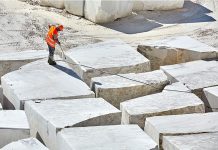
Marble quarrying in antiquity required extraordinary technical expertise. Ancient Greek quarrymen had an in-depth understanding of the rock’s structure and exploited its natural discontinuities and fractures. Using iron tools and wedges, they extracted massive blocks, which they then shaped on-site. Transporting them was a true technological achievement, carried out using complex rolling systems, followed by carriages and ships. The ancient quarries of Paros, Naxos, Thassos, Penteli, Hymettus, Proconnesus, Lesbos, Karystos, Larissa, Crete, and many other regions stand today as unique monuments of ancient Greek technology.
One of the most interesting fields of modern scientific research concerns determining the provenance of marbles used in ancient artworks and monuments. Knowing the origin of marble contributes to understanding ancient trade networks and technological knowledge, as well as enabling the proper restoration of monuments. Advanced geological and archaeometric methods are employed today for this purpose. Among the most important methods are thin-section petrographic microscopy, X-ray diffraction (XRD) analysis, and stable carbon and oxygen isotope analysis. No single method alone is sufficient for the reliable identification of a marble’s origin. As part of my research at the Department of Geology at AUTH, I created an extensive database comprising geological and geochemical characteristics of marbles from most quarrying centers in Greece, Asia Minor, and Italy. This database, combined with the aforementioned analytical methods, is used to identify the provenance of marble archaeological artifacts, contributing to a better understanding of marble trade networks and usage in antiquity.
In modern times, Greece continues to hold a prominent position in the international marble market. Quarries in Thassos, Drama, Kavala, Vermio, Kozani, Magnesia, Mani, Paros, Naxos, Argos, and many other areas produce high-quality marble exported to dozens of countries. Snow-white Greek marble adorns temples and mosques, public buildings, hotels, skyscrapers, and cultural centers around the globe, from Europe to the Middle East and Asia.
Greek marble is much more than just a stone or building material. It represents a unique link connecting Greece’s geological history with the history of human civilization. It was forged through complex geological processes lasting millions of years and was sculpted by human hands into peerless works of art. The ancient quarries of Greece, alongside the sculptural masterpieces and monuments built from Greek marble, constitute a precious cultural heritage. Protecting and highlighting them is not only an obligation to our past, but also a significant legacy for future generations.