

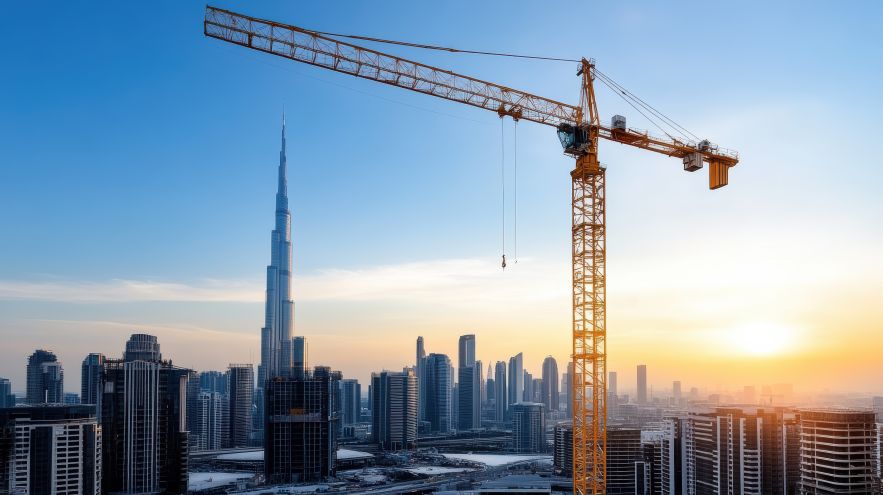



Hotel development, large-scale urban programmes and infrastructure investment are shaping a broad field of activity across Africa and the Middle East. For natural stone businesses, these developments provide a reason to monitor emerging markets, assess potential partnerships and identify projects where natural materials could be specified for particular applications.
According to the 2026 hotel-chain development survey, based on data from 53 hotel groups, Africa has 675 hotel projects in its development pipeline, representing 123,846 rooms. In the Middle East, the corresponding pipeline includes 724 projects and 178,003 rooms, based on figures for the second quarter of 2026.


These figures illustrate the scale of development activity across the two regions. However, they do not represent completed hotels or confirmed material orders. Their relevance to the natural stone industry lies primarily in identifying markets and projects that may generate future procurement requirements.
Africa: Egypt, Morocco and emerging markets
The geographical distribution of hotel projects highlights several countries with a notable presence in the development pipeline. Egypt leads the selected African markets with 185 hotel projects and 45,984 rooms. Morocco follows with 75 projects and 10,606 rooms, while Nigeria has 57, Kenya 35, South Africa 31 and Tanzania 29.
This distribution offers an initial indication of the markets worth monitoring for natural stone suppliers. However, the inclusion of a project in a development pipeline does not necessarily mean that funding has been secured, construction has started or material procurement is already open. Assessing each opportunity requires information on its implementation stage, specifications and the organisations responsible for procurement decisions.
Egypt: Hotel projects and urban development
Egypt stands out both for the scale of its hotel development pipeline and for its broader urban development programmes. The 185 hotel projects, representing 45,984 rooms, make it one of the most significant individual markets covered by the African survey.
Alongside hospitality development, the country’s initial smart-city strategy covers 24 new fourth-generation cities, designed to accommodate a total of 14 million residents. These figures refer to the stated scope and intended capacity of the strategy, rather than 24 completed cities or their current population.
The two development areas point to different types of material requirements. Hotel projects may place particular emphasis on architectural identity, interior applications and material consistency across large spaces. Wider urban programmes, by contrast, can involve different project categories, applications, budgets and procurement procedures. For natural stone businesses, understanding the specific application and identifying the relevant decision-makers are essential before approaching a potential project.
Morocco: Hotel development and airport investment
Morocco combines tourism development with a broader programme of investment in aviation infrastructure. The 2026 survey lists 75 hotel projects and 10,606 rooms in the country’s development pipeline.
Separately, the government’s 2025–2030 airport agreement provides for investments totalling MAD 38 billion. Of this amount, MAD 25 billion is allocated to capacity development, while MAD 13 billion is earmarked for maintenance, modernisation and land acquisition.
The programme includes expansion works at the airports of Marrakech, Agadir, Tangier and Fez, as well as a new hub terminal and runway at Casablanca’s Mohammed V Airport.
These investments concern broader infrastructure development and do not correspond to specific natural stone procurement budgets. Nevertheless, the parallel development of tourism destinations and public infrastructure makes it important for suppliers to monitor individual projects, technical requirements and procurement procedures.
Middle East: Market scale and the importance of timing
In the Middle East, the hotel construction pipeline includes 724 projects and 178,003 rooms at the end of the second quarter of 2026. Projects are classified according to their stage of development, ranging from early planning to those scheduled to start within the following 12 months or already under construction.
For natural stone suppliers, this distinction has direct commercial relevance. During the early planning stages, discussions may focus on material selection, design concepts and potential applications. As a project approaches construction, technical specifications, quantities, samples, commercial terms and production and delivery schedules become increasingly important.
For projects already under construction, requirements may be more operational, involving the availability of specific material batches, fabrication coordination, packaging and phased deliveries. The size of a market alone is therefore insufficient to assess a commercial opportunity. Equally important is the stage reached by each project and whether its procurement process remains open.
Saudi Arabia: Large-scale hospitality and urban development programmes
Saudi Arabia is one of the markets where the development of new destinations is closely linked to large-scale hospitality and residential programmes. Diriyah’s masterplan lists 40 hotels, while the announced plan for The Red Sea includes 50 resorts and up to 8,000 hotel rooms by 2030.
In residential development, NHC’s footprint covered 25 urban destinations across 17 cities as of November 2025. These figures describe different categories of development activity and should not be confused or added to the regional hotel pipeline.
For natural stone businesses, these programmes highlight the importance of connecting a project’s architectural identity with reliable supply capabilities. Material selection involves more than colour or surface appearance. Availability, documentation, approval requirements and the supplier’s ability to meet the quantities and delivery schedules of a project are also key considerations.
From development figures to commercial assessment
The overall picture across Africa and the Middle East underlines the importance of monitoring these markets while carefully assessing each potential opportunity. Hotel pipeline figures, urban development programmes and infrastructure investments represent different indicators and cannot automatically be translated into specific demand for marble and natural stone.
For businesses in the sector, the next step is to identify which projects have reached a stage suitable for commercial engagement, which applications may require natural materials and which organisations are involved in design and procurement decisions. The ability to present suitable materials, provide technical documentation, maintain production capacity and ensure reliable deliveries are all important factors in developing business partnerships.
In this context, Stone Africa 2026, taking place from 12 to 15 November at the Cairo International Convention Centre in Cairo, offers a meeting point for professionals interested in exploring markets across the region. The exhibition can facilitate direct contact between suppliers and buyers, material assessment and the exploration of potential partnerships around specific project requirements.
For natural stone businesses, the challenge is not simply to identify where the largest investments are being planned, but to understand where their products and capabilities can offer tangible value.
Stone Africa 2026 will take place from 12 to 15 November 2026 at the Cairo International Convention Centre, Nasr City, Cairo, Egypt.
Source: Stone Africa – Articles and Market Insights 2026