




Algeria is seeking to strengthen its position in the international natural stone industry, combining efforts to expand domestic marble production with a growing emphasis on export development and international partnerships. Its participation in the 60th edition of Marmomac, held in Verona from 22 to 25 September 2026, highlighted this direction, bringing together five Algerian companies under the auspices of the Ministry of Foreign Trade and Export Promotion.
The country’s presence at one of the industry’s leading international exhibitions reflects a broader ambition to move beyond a market primarily focused on import substitution and develop a more active role in international marble trade. While Algeria has considerable geological resources, its ability to translate this potential into a competitive export industry will depend on production capacity, processing technology and access to established commercial networks.


Marmomac 2026: A platform for international partnerships
One of the most notable developments associated with Algeria’s participation in Marmomac was an agreement signed by Algerian company SARL NOUR with an Italian commercial partner. According to Algeria’s state news agency, APS, the cooperation aims to facilitate the export of Algerian marble to China, using Italian commercial expertise and established international business connections.
The agreement represents an important step in the country’s efforts to develop new export channels. However, its commercial impact will depend on the implementation of the partnership, the volumes involved and the ability of Algerian producers to meet the requirements of the Chinese market.
The initiative also illustrates the potential role of European companies as intermediaries and partners in the internationalisation of Algeria’s natural stone industry, extending beyond traditional equipment and technology suppliers.
Italian expertise and the development of domestic processing
A central element of Algeria’s industrial ambitions is the improvement of its domestic marble processing capabilities.
In this respect, cooperation with Italy predates Marmomac 2026. In July 2025, the Italian Trade Agency (ICE) signed a technical cooperation agreement with SONAREM ETTakwine, a subsidiary of the state-owned mining group SONAREM, providing for the establishment of an Italian-Algerian technological training centre for marble and decorative stone.
The initiative focuses on technology transfer, technical training, modern equipment and the development of expertise in quarrying and processing operations. It is supported by Italian and Algerian industry organisations, including Confindustria Marmomacchine and the Algerian Federation of Marble and Natural Stone Industries (FAMMIP).
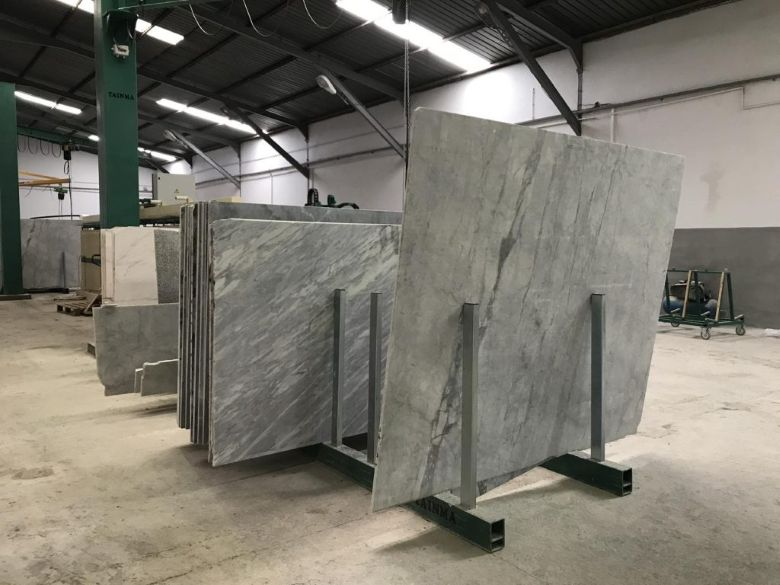
The cooperation reflects a strategic objective that goes beyond increasing the extraction of raw materials. By improving its processing infrastructure, Algeria aims to develop a stronger domestic industrial chain and increase the share of higher-value products in its future exports.
For Italian machinery manufacturers and technology providers, this direction could create opportunities in a market seeking to modernise its production facilities and improve operational efficiency.
SONAREM and the potential expansion of marble production
The state-owned SONAREM group plays a central role in Algeria’s efforts to develop its mining sector, including marble and decorative stone.
According to statements made by SONAREM’s chief executive, Belkacem Soltani, the group oversees more than 15 quarries involving marble and other natural stone materials, with approximately 40 million cubic metres of exploitable reserves. The same statements refer to estimated national marble resources of 140 million cubic metres, although other published estimates have cited different figures.
Soltani has also indicated that annual production could potentially reach 10 million cubic metres through cooperation between SONAREM and private Algerian companies.
This figure should be understood as a production ambition or potential capacity rather than an indication of current output. Achieving such a level would require substantial investment in extraction equipment, processing infrastructure, logistics and technical expertise.
Nevertheless, the scale of the resources identified and the involvement of both public and private companies indicate the importance Algeria attaches to developing its domestic natural stone industry.
Import substitution and the changing structure of the Algerian market
Alongside its export ambitions, Algeria continues to pursue policies aimed at reducing dependence on imported finished and semi-finished products.
The issue has direct implications for traditional marble suppliers, particularly in Mediterranean countries such as Greece, Italy, Spain and Turkey.
The European Commission has formally challenged Algerian trade restrictions, including the prohibition on imports of finished and semi-finished marble products. In July 2025, the Commission requested the establishment of an arbitration panel under the EU-Algeria dispute settlement framework, identifying restrictions affecting European exports and investments.
The commercial significance of the Algerian market is illustrated by international trade data for 2024. Algeria imported approximately $32.3 million worth of marble and travertine simply cut into square or rectangular blocks (HS 251512).
Greece was the leading supplier in this category, with exports worth approximately $8.55 million, followed by Egypt with $7.27 million, Turkey with $6.02 million and Italy with $5.79 million.
These figures underline the importance of Algeria as a destination for Mediterranean marble producers. They also highlight the potential consequences of continued restrictions on imports of processed materials.
However, the distinction between finished products and raw or roughly trimmed marble blocks remains important. The available trade data do not indicate that all categories of imported marble have been eliminated, and the evolution of these trade flows will depend on both regulatory developments and the expansion of domestic production.
The $290 million import bill and the economic rationale for expansion
The economic motivation behind Algeria’s efforts is also reflected in the country’s previous dependence on imported marble products.
SONAREM’s chief executive has stated that Algeria spent approximately $290 million on imports of finished and semi-finished marble products over a three-year period.
Although this figure has been reported as a statement by the company’s management rather than independently verified as a consolidated trade statistic, it illustrates the economic rationale behind the government’s efforts to strengthen domestic production.
Reducing imports, developing local processing capacity and increasing exports are interconnected objectives. The development of the marble industry is therefore part of a broader national strategy to diversify economic activity beyond hydrocarbons, encourage industrial investment and create employment.
Algeria’s ambitions in the mining sector extend beyond marble, encompassing other mineral resources that the country seeks to develop for domestic industrial use and international markets.
China and the future of Algerian marble exports
China represents an important potential destination for Algerian marble, particularly as the country seeks to establish new commercial partnerships and expand its international presence.
However, current trade figures indicate that Algeria remains a relatively small supplier. Its exports to China in the HS 251512 category were still limited in 2024, demonstrating the considerable gap between the country’s export ambitions and its existing market position.
The agreement involving SARL NOUR and an Italian commercial partner at the time of Marmomac 2026 should therefore be viewed as an initial step towards developing this relationship rather than evidence of an established large-scale export presence.
For European marble producers, particularly those competing in Asian markets, the development of Algeria’s export capabilities is nevertheless worth monitoring. The country’s geological resources, geographical position and efforts to attract international technical expertise could support a stronger presence in global trade over the coming years.
Realising this potential, however, will require consistent product quality, competitive processing capabilities, reliable supply volumes and the development of long-term commercial relationships.
A developing player in the international natural stone industry
Algeria’s participation in Marmomac 2026 highlighted a broader transition in the country’s approach to the natural stone sector. Its priorities increasingly combine domestic industrial development, technological cooperation and the search for new export opportunities.
The country’s substantial geological resources provide a basis for expansion, while cooperation with Italian companies and the agreement targeting the Chinese market indicate a growing interest in international integration.
For the Mediterranean natural stone industry, this development presents a dual perspective. Algeria may offer new opportunities for machinery manufacturers, technology providers and industrial partners, while its future production growth could gradually increase competition in international marble markets.
The extent to which these ambitions translate into a stronger export position will ultimately depend on the pace of investment, the development of processing infrastructure and the country’s ability to establish a consistent presence in international supply chains.