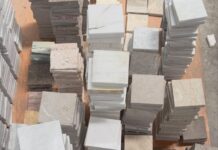






The Egyptian marble and granite industry is undergoing a radical restructuring as the country attempts to transition from a model of small, informal workshops to a fully organized, vertically integrated industrial network with a strong export orientation.
According to an extensive report by the financial network Arab Finance, this strategic shift comes at a critical juncture. Recent official data from the General Organization for Export and Import Control (GOEIC) reveals that Egyptian marble and granite exports recorded a 23% year-on-year decline in the first quarter (Q1) of 2026, dropping to $60.9 million.


The “Revolution” in Shaq Al-Taaban and the New Industrial Model
The heart of Egyptian production, the iconic Shaq Al-Taaban area in Cairo—ranked among the largest marble industrial zones globally—is the epicenter of this transformation. The government is implementing a comprehensive legalization and infrastructure modernization program, turning what was once a chaotic cluster into a modern, regulated industrial hub with lower logistics costs and upgraded services.
At the same time, the country’s new production ecosystem now relies on complementary regional zones:
-
Aswan: Solidifying its position as the primary hub for extracting high-quality granite.
-
Galala: Evolving into a model center for advanced processing and exports, equipped with state-of-the-art technology.
Shifting Focus to High-Value Finished Products
As Egyptian market executives point out, the domestic construction boom of recent years (driven by mega-projects like the New Administrative Capital and New Alamein) served as a incubator for local producers. Companies gained the necessary liquidity and expertise to invest in modern cutting and finishing machinery.
The ultimate goal is for Egypt to move away from exporting low-margin raw blocks and dominate international markets with finished, standardized products of high added value, directly targeting the Gulf, European, and African markets.
The $1 Billion National Target
This initiative is part of the Egyptian government’s broader strategic plan, which includes increasing the number of active quarries by the end of 2026. The ultimate objective is to drive the sector’s annual exports to the $1 billion mark.
For international market players and global exporters, Egypt’s transition to a more organized and technologically advanced model is a development that redefines the competitive balance in the Eastern Mediterranean region.