





By Markus Balke & Joseph Sam, Balke & Partners www.BalkePartners.com
Introduction


Through the sands of time, across civilizations the use of natural stone for architecture, roads, walkways, gardening, infrastructure, tools and weapons wasn’t uncommon. The timelessness, durability & beauty of stones has evolved its applications from mere structural use to interiors and home décor & furniture as well. Whilst conventionally it’s application still is largely for floorings, cladding, monuments & counters the nature of natural stone in ensuring temperature neutrality, its non-synthetic texture, inconsistency in pattern and organic benefits give it a wider bandwidth of applications. Natural stone unlike any synthetic option is formed geologically over thousands of years and none of the pieces can ever be identical hence the application of natural stone implies a sense of uniqueness unlike factory made options where consistency & pattern perfection are calibrated.
Normally when our clients who are architects, designers, end users, processing companies and mine owners ask us about how certain stones can be applied we make them understand that it’s important to comprehend the stone beyond its aesthetic presentation. At the onset it’s important to understand the types of natural stones and how their nature can be leveraged for different applications based on weathering, usage and load/ pressure to be taken. Each of them brings in a certain texture, design variety and application to the space be it on the exterior or interior or as a product.
Broad Natural Stone Typology
Based on our experience and to cater to a wider demographic of readers we thought its best to capture a few of our own observations, experiences and knowledge in the public domain in a tabular form which we’ve tried to put as succinctly as possible below:
| Stone Type |
Visual & Chemical Characteristic |
Application |
| MARBLE | Known for its timeliness, its wide range of applications, elegant veining, color variance and smooth finish. Marble has a high thermal mass so it absorbs heat and conducts it faster hence the rooms stay cooler with marble flooring. | Flooring, Cladding, Building façade, Staircases, Pillars, Counter tops, Interior Sculpture, Decorative fireplace, Monuments, Accent tables, Décor, Furniture and industrial uses (e.g. abrasives). |
 |
 |
|
| GRANITE | Speckled or mottled appearance due to interlocking mineral crystals (primarily feldspar, quartz, and mica), dense look and can be used polished or matted or can also be texture treated (leather, flame, brush finish etc). Unlike Marble, Granite is very resistant to chemical weathering and has high thermal stability. | Granite being lesser versatile than Marble it has limited applications but is more durable and can weather a variance of climatic conditions unlike Marble. It can be used in flooring (mostly external), cladding, hardscaping, public spaces, sculpture & infra, has limited colour options but with stronger texturization than marble and is highly durable. It can be used in counters & certain colors in decorative products. It is harder to work on than marble. |
 |
 |
|
| ONYX | Onyx is a translucent, banded variety of chalcedony quartz (a silicate mineral) and is softer, delicate and more translucent that Marble. Only experts can know the difference between marble and onyx, but onyx is more expensive especially as it is valued for its translucence & display of internal texture of the stone. Due to its relative softness and high porosity, it is best suited for low-traffic applications. | On account of its softness and fragility Onyx has limited uses but architects and interior designers have often used it in high end projects for highlights, for backlit staircases & wall cladding, Bathroom & Spa features, furniture, Counter tops & Bar tops in entertaining areas, lighting fixtures & decorative accents and fireplace surrounds. It has extensive application in jewellry, decorative and sculpture but is extremely brittle so needs careful handling. |
 |
 |
|
| TRAVERTINE | Travertine is a porous, sedimentary limestone formed by rapid precipitation of calcium carbonate, has a lot of pores due to trapped gas having escaped and it features a banded, fibrous, or pitted texture with earthy tones (white, cream, tan, and brown). Chemically, it is mainly calcite, often containing iron and manganese impurities. As a type of limestone, it reacts to acidic substances leading to etching. | Used in flooring, wall cladding, facades, pool side decks & patios, landscaping, bathrooms & kitchens in the polished, honed, brushed, tumbled and sandblasted form. |
 |
 |
|
| SLATE | Slate is a fine-grained, foliated metamorphic rock recognized by its ability to split into thin, smooth, and durable sheets and has a matted or dull silky look. It is high in silica & alumina content, thermally stable, chemically inert & highly acid resistant. | It is mostly used in flooring, cladding and roofing in colder climates prone to snowing. Additionally, it is nowadays used in worktops, houseware and public space furniture in colder countries. |
 |
 |
Applications
The application of natural stones can broadly be divided into 3 categories:
- Spaces: Outdoor & Indoor, Flooring, Cladding, Hardscaping, Counters & Slabs.
- Products: Sinks, Fountains, Spa & Bath products, Furniture, Lighting, Fireplaces, Decorative accessories etc
- Art: Sculpture, Wall mountings, Bookmatched Patterns, Installations etc.
 |
 |
Why & How to style your space with Natural Stone?
Unlike synthetic or factory materials where there is a sense of industrialization or assembly line uniformity the usage of natural stone means that even the most consistent & uniformly produced set of products will be different from each other due to the natural pattern inconsistency, so no two products can ever look like mirror images. Natural stone unlike any other materials has the distinction to stand out & that can be singular in nature, appearance & there is always a story behind the origin of every piece. This being is said one of the things that has to be kept in mind is that the source of every natural stone pattern is finite and at some point, the pattern will get exhausted and the value of the stone increases hence in the long run natural stone products have an enduring if not increasing value.
Natural stone applications can vary space to space, but we have summarized our experience with a large number of clients in a succinct manner below relative to each space (not an exhaustive list):
Kitchen:
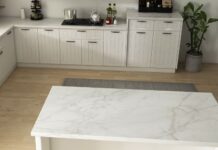
Known as the heart of the home it is the most popular space for natural stone applications from counter tops to slabs and flooring. This is to ensure that it has the highest probability of stains, spills, constant cleaning (surface wearing), and the variety of ingredients, fumes, oils and products (wet & dry) the surfaces here are exposed to. Based on budgets even a place like the kitchen can have its accentuated areas such as counter tops and sinks. Recently full kitchen solution manufacturers have started using natural stone as highlights within their more industrialized offerings. The combined expectation in the kitchen space is the blend of durability, sustainability & workability.
 |
 |
Bedrooms:
This is the private space of the home and yet it is supposed to exude comfort, security and intimacy. The bedroom can have feature walls and ceilings made of natural stone (even in mixed media), floorings that can be cooler than ceramics, fireplace (functional or merely aesthetic), architectural detailing through stone columns, inlay windowsills and custom stone highlights ensuring there’s a sense of permanence to the architecture. There can also be marble topped nightstands, lamp bases, carved onyx pieces and marble inlay work on furniture combined with wood.
 Living Room:
The living area is the public space within the private space where visitors are entertained and the space everyone person uses to not just impress outsiders but also convey something about themselves, their tastes and overtly or subtly their standing in society. Integrating stone into the room’s interior adds a sense of historical permanence. The application of natural stone in the living room can vary from combination floorings (color, stone type and material mixes) to statement walls and media centres to decorative highlights and well-crafted décor pieces. As the public space within the house, it could also have a stone fireplace, doorways, archways, veneer panels, built-in bookcases and signature stone furniture such as a coffee table, marble or onyx topped side tables or lamps and solid stone plinths for displaying sculptures eliciting the material’s geologic beauty as a highlight conversation piece. There can also be décor pieces from centre bowls & sculpture to ashtrays to coasters made from stones/ combination with mixed media and even stone based chandeliers or lighting.
 Dining Room:
Natural stone in a dining room elevates the entire dining experience, bridging the gap between everyday durability and formal sophistication. As a space dedicated to gathering and entertaining, the dining room allows for stone applications that are both highly practical and visually commanding. A solid natural stone dining table is the ultimate centrepiece & can be crafted to convey a sense of grandeur and permanence. Because stone is heavy, these tables often feature sturdy, architectural bases in complementary materials like brass, blackened steel, or carved wood. The dining table can also have a stone slab serving station or it can also be a separate table with a durable surface to place hot serving dishes. Besides this there can be wet bars, feature walls, wine niches, backlit or toplit crockery cabinets in natural stone such as marble or onyx.
 Recreational Room & Cellars:
This has a wide bandwidth of possibilities as this is the space used to entertain oneself as well as visitors. This can include a viewing room, gaming (physical and virtual), wine cellar/ bar, a lounge that can be formal/ semi formal. This space is supposed to be warm, restful and cheerful and natural stone can be used on the flooring, walls and ceilings here to also ensure there’s durability (to cleaning besides the traffic), a cool ambient temperature and a rustic warmth. Dark matte stones can absorb screen light especially strobe lighting and also it helps in ensuring the right kind of acoustics. The stones here need not be polished but honed or textured (leather / brushed / sandblasted).
 Garden Pool and External areas:
Natural stone is arguably in its most authentic element when used outdoors. In gardens and pool areas, natural stone bridges the gap between the built environment and nature, offering unparalleled durability against the elements while aging gracefully over time. Almost every natural stone can be used in this area unlike other areas. Pools can have natural stone decking treated with textured or flamed finish to ensure slip resistance. There can also be stone patios & paving in combination of stones and colors with irregular flagstones as well. The aim is to ensure safety, weather-resistance and rustic aesthetics. There can be pathways along the landscape highlighted by stones as well as areas with sculpture, formal garden areas and retainer walls with creepers growing. Beyond the pool itself, stone is the ideal medium for fountains, cascades, and ornamental ponds.
Bathrooms:
This is the haven for a homeowner and everyone’s most private space in their homes. Today’s homes are a Spa-Like Sanctuary for many evoking a sense of serenity, intimacy and security. Natural stones enhance this feeling and some of the interesting applications can range from shower enclosures to statement tubs, pebble flooring, highlight sinks to décor product ranges (soap dishes, toothbrush / shaving razor holder, tissue box, soap dispenser, mirror cabinet and dustbin).
 How we’ve been leveraging the potential of Natural Stone at B&P
At Balke & Partners we’ve had a wide bandwidth of experience while working with companies, designers and quarries to develop products that are emblematic of the specific character, typology and nature of stone but what we’ve captured below are some of the more common experiences. We have worked on assignments where we have taken up a unique stone type and through the ideation process evolved products that are traditional as well as those that are unique to the stone’s characteristic, the story of its origin or location and its availability. We will be presenting a brief CASE STUDY of a recent assignment we executed for a client of ours.
Brief: The client has a quarry which is based in North America and approached us to assist them build the business and we collectively identified 3 deliverables: 1) Create an identity for the stone due to its distinct pattern and nature 2) Increase their geographic reach beyond Europe to the Middle East, South Asia and S.E.Asia 3) Increase the business turnover. Our playbook took various additional issues into factor including the cost of mining, cost of logistics, comparison of the design pattern to peers, markets with the demand for marble stones with specific patterns/ colors and the pricing in the markets we had identified.
We outlined a 4 phased roadmap that we rolled out across 6 months:
- Phase 1: Brand Identity & Positioning
Creating a distinct identity requires moving beyond selling a stone to selling a legacy and an aesthetic. We positioned the stone in sync with the craft basin that existed in the same region to show that the basin & the stone had a similar design narrative. Three of the primary actionable areas we worked on were:
- Evocative Naming and Storytelling: We assigned a name to the stone which was coherent with the name of the region and which the craft was associated with as well. This resonated a historically respected lineage.
- The Sustainability Narrative: We emphasized on the aspect of ‘ARTISANAL’ to diminish the emphasis on industrialization. Like the craft we pushed the word ‘sustainable’ and introduced sustainable extraction methods with minimal environmental impact. This narrative builds trust and aligns with global corporate standards.
- Visual Identity: We developed a distinct identity that positioned the marble not just as a building material, but as a high-design architectural and design element which had a wide bandwidth of applications, conventional, innovative and new.
- Phase 2: Product Evolution & Application
To increase business turnover, diversify the offerings beyond traditional raw blocks and slabs to value-added products and versatile applications such as décor, book matched highlights & features and sculpture & furniture that captured the pattern of the stone illustrating the extensive possibilities of the stone.
- Beyond the Slab: Expand the product line into bespoke interior products. This includes statement furniture (dining tables, coffee tables), lighting fixtures, luxury bathroom fittings, and intricate wall-cladding panels. We connected with artisans, architects, product/décor designers in coming out with collections that were representative of their own
- Designer Collaborations: Partner with high-profile interior designers and architects to create exclusive, limited-edition capsule collections using this specific pattern. We identified every geography’s key influencers (in the GCC it was the architects & retailers, in India the processors and architects were the influencers, in China it was the processors & wholesalers, in Europe the Architects and in the US the designers & masons) and came out with a step by step strategy of reaching out to them. The versatility of the stone was shown in high end retail projects such as that of the interiors of Harrods, Dubai Atlantis and upmarket residential projects in London wherein the designers created highlights, combinations of this stone along with other popular stone such as luxury Italian stones of character and had commissioned furniture made.
- Social media idea engagement & aggregation: We harnessed the power of social media especially Instagram, Pinterest and LinkedIn in aggregating ideas and as well as presenting product development outcomes with the dual deliverable of marketing the stone as well as allowing the vast universe of the digital world to give feedback on the designs. Some of the ideas we got were from veneer applications to using it with other material in bringing out luxury craft products. One of the interesting ideas we got with the stone (it also behaved like ONYX) was to integrate it with LED lighting and present backlit or inside lit décor products. Another one was a SPA range of treatment chairs and tables as well as related décor (oil dispensers, diffusers, etc).
- Phase 3: Regional Market Penetration Strategies
Each target market requires a tailored approach based on its unique economic landscape and aesthetic preferences.
- The GCC (Saudi Arabia, UAE, Qatar, Bahrain & Kuwait)
- Focus: Opulence, mega-projects, and luxury hospitality.
- Strategy: Target major developers, architects & interior designers involved in initiatives like Saudi Vision 2030 (NEOM, Red Sea Project) and high-end Emirati real estate. Emphasize the marble’s exclusivity and capacity to elevate ultra-luxury spaces. Establish partnerships with elite architectural & design firms in Dubai, Riyadh and Doha.
- India
- Focus: Luxury Residential, Boutique Commercial projects and large luxury developments (residential & mixed use).
- Strategy: India has a deep-rooted appreciation for natural stone. Blend the contemporary appeal of the new pattern with traditional, grand applications. Focus on Processors, Architects and Developers who are the key influencers in Tier-1 cities and create strategic alliances with premium interior design studios. Focus on high-touch, VIP experiential centres in key metropolises.
- China
- Focus: Scale, prestige, and commercial luxury.
- Strategy: China is the world’s largest supplier of processed stone so while the domestic market there is significant its important to look at China’s status as manufacturer to the world and leverage it to access markets in North America, Europe and S.E.Asia. So we aimed to establish a robust B2B distribution network through partnerships with top-tier Chinese stone importers and distributors and participate in major regional trade shows (like the Xiamen International Stone Fair) with the entire product bandwidth to secure large-scale contracts.
- Phase 4: Strategic Marketing & Revenue Acceleration
While the strategy varies market to market, region to region & country to country we’ve summarized what we’ve done broadly as below:
- B2B Architectural & Design Outreach: We created a dedicated outreach program for global architectural and design firms including artists and artisans who could customize the design process into product categories and experimental projects. We provided them with the brief, the stone characteristics, the target markets & price points and then the stone itself based on what they intended to do with it. The outcomes were shared by them with their target markets and also shared by us on social media handles as a part of the growing possibilities with the product.
- Immersive Experiential Marketing: Host exclusive launch events in key financial and cultural hubs within the target regions especially in cultural centres & embassies. Use VR setups at these events to let stakeholders walk through digitally rendered spaces featuring the new marble pattern.
- Tiered Pricing Strategy: Introduce a tiered pricing model based on the sizes, application, and exclusivity of the specific vein variations within the pattern. This allowed our client to capture both the ultra-luxury bespoke market and the premium commercial bulk market.
- Targeting high profile projects through developers/ architects: This can include hotels, commercial complexes, shopping malls and luxury residential projects.
- Build partnerships with local distributors: This is to ensure a strong presence in the premium design and construction sector through local retailers, wholesalers and processors.
- Participate in international design and construction trade shows: This includes showing blocks, slabs, products and projects through VR set ups.
- Conclusion:
Ultimately, natural stones like marble, granite, and onyx remain unparalleled in their conventional applications. Their intrinsic durability, unique veining, and timeless aesthetic continues to anchor traditional product design, from luxury architectural elements and surfaces to statement furniture. However, their true potential in the modern era lies far beyond these historical boundaries.
Driven by rapid advancements in precision manufacturing such as CNC milling, 3D profiling, waterjet cutting, and ultra-thin slicing these ancient materials are experiencing a renaissance in unconventional product design. Designers are no longer constrained by the traditional weight and rigidity of stone, allowing for highly innovative applications that can prove that the earth’s oldest materials still have a dynamic and vital role to play in shaping the future of industrial and product design.
 |
 |
Contact:
For more information feel free to write to us on josephsam@balkepartners.com to understand how we can help you on your journey to building a natural stone brand globally as well as accessing new markets, evolve new product categories and expand your market share.