





Market Analysis: Waning Chinese demand weighs on raw block exports, while high-value-added processed products maintain a defensive stance in the Middle East and the US.
A decade-long growth cycle marked by intense volatility is drawing to a close for the Greek marble sector, with Q1 2026 data confirming that the industry faces a profound structural shift. Total export activity exhibits a clear deceleration, retreating to 2016 levels and losing the momentum of the golden 2017–2018 biennium. However, behind the decline in overall aggregates lies a radical redistribution of the country’s export profile: the center of gravity is decisively shifting away from raw block sales toward finished, high-value-added products.


Total export performance and the return to baseline
Following the impressive rise of the 2016–2018 period—when export value surged from €50.24 million in Q1 2016 to €92.03 million in the corresponding quarter of 2018, and volumes grew from 129.8 thousand tons to 240.1 thousand tons—the sector entered a phase of gradual correction. The COVID-19 pandemic in 2020 dealt the first severe blow due to disruptions in global construction activity, limiting exports to €63.12 million (156.4 thousand tons), while the temporary recovery of 2021 to €74.12 million proved short-lived.
From 2022 onward, international demand weakened steadily, with export value settling at €66.42 million in 2022, €68.46 million in 2023, and €65.55 million in 2024. This downward trajectory persisted into 2025, when value contracted to €61.55 million and volumes to 157.5 thousand tons.
This trend became even more pronounced in Q1 2026, with total exports dropping to €52.62 million and volumes to 136.6 thousand tons. Compared to the historical high of 2018, value is down by 42.8% and quantities by 43.1%. The nearly identical decline in both volume and value underscores that the downturn is not merely a reflection of price fluctuations but stems from a broader contraction in international absorption, bringing the industry remarkably close to its starting point of a decade ago.
The gradual shift in export composition
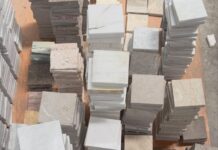
The most significant development for the sector does not concern the reduction in overall figures, but rather the complete reversal of the balance between raw material (Marble Blocks & Slabs) and finished, processed products (Finished Marble Products).
In Q1 2018, raw marble dominated entirely, accounting for 65.39% of the total export value, compared to just 34.61% for processed goods. Eight years later, in Q1 2026, the scenario completely reversed: processed products captured 59.63% of the export value, leaving raw marble at 40.37%.
Notably, this restructuring primarily impacts export value rather than volume, as raw marble still constitutes 72.77% of the total tonnage exported in 2026. This demonstrates that while the industry continues to move large volumes of raw material, the primary engine of wealth generation and commercial value has transitioned to finished products of higher added value.
Raw marble trends and the Chinese market
The trajectory of Greek raw marble remains inextricably linked to the Chinese market, which, despite its shrinking imports, absorbed 73.11% of the value and 77.30% of the volume of this category in Q1 2026.
During the high-growth period (2016–2018), the value of raw exports had risen from €20.14 million to €60.18 million, with China advancing from €15.92 million to €50.67 million. However, in Q1 2026, the total value of raw marble was limited to €21.24 million (a 64.7% drop from 2018), and volumes retreated to 99.4 thousand tons. Accordingly, exports to China fell to €15.53 million and 76.9 thousand tons.
The Chinese market no longer operates under the terms of the previous decade. A prolonged crisis in the country’s real estate sector and a strategic shift toward cost management have drastically compressed prices. The average price per ton for exports to China experienced a free fall, dropping from a historical high of €401.12 in 2019 to €202.08 in 2026.
The average price of Greek raw marble in China (€202,08/ton) has now marginally converged with the corresponding price of Turkish marble (€200.81/ton). The erosion of the traditional pricing premium, combined with simultaneous volume reductions, exerts severe pressure on the profit margins of Greek enterprises, particularly in an environment of rising extraction and operational costs.
The steady course of processed products
In stark contrast to the volatility seen in raw materials, processed marble products displayed remarkable stability. The value of these exports stood at €31.38 million in Q1 2026, remaining virtually on par with 2016 levels (€30.10 million) despite international crises, with the highest peak recorded in 2025 at €38.70 million.
Exported volumes moved from 46,987 tons in 2016 to a historical high of 53,875 tons in 2020, before settling at 37,204 tons in Q1 2026. The resilience of the overall value was sustained by a continuous improvement in the average price per ton, which rose by 31.7% over the decade, climbing from €640.69 in 2016 to €843.50 in 2026 (with a record high of €869.36 achieved in 2024). This progression confirms that Greek processed marble maintains a strong position in international markets and caters to high-specification projects.
Key destinations and regional challenges
Although processed products exhibit greater geographical diversification compared to raw materials, concentration remains high, with the top five countries absorbing 68.24% of the value and 52.94% of the volume in Q1 2026.
The most striking development concerns Saudi Arabia. Propelled by the massive construction projects of the Vision 2030 program, this market evolved into the leading destination, with export value skyrocketing from €1.81 million in 2016 to an all-time high of €9.61 million in 2026. Concurrently, volumes increased from 2,361 to 6,264 tons, and the average price per ton doubled, reaching an impressive record of €1,534.
The United States remains the historical market with the highest value-added component, recording an average price of €1,782 per ton in 2026. However, demand appears subdued at €4,21 million in 2026 (compared to €4.86 million in 2016 and a peak of €7.66 million in 2021), with volumes limited to 2,365 tons due to the slowdown in American residential and commercial construction.
Conversely, the market of the United Arab Emirates experienced a noticeable downturn after 2023. In Q1 2026, value was constrained to €3.12 million and volume dropped to its lowest level of the decade (3,378 tons), despite the average price per ton hitting a historical high of €923.74. This contraction was heavily concentrated in March 2026 (yielding just €169 thousand in value and 275 tons in volume), a dip that aligns chronologically with escalating tensions in the Persian Gulf and severe disruptions to shipping lanes through the Strait of Hormuz.
Conclusion and future outlook
The Q1 2026 results indicate that the Greek marble industry is not in an immediate crisis, but rather entering a phase where safety margins are narrowing. A high reliance on a limited number of markets—with just five countries absorbing 68.77% of total value and 74.46% of sector volumes—heightens its vulnerability to global developments.
Changing conditions in China, geopolitical uncertainties in the Middle East threatening construction timelines, shipping route disruptions, and rising freight rates add further weight to already elevated production, energy, and labor costs. In this shifting landscape, broadening corporate geographical footprints, investing further in integrated downstream processing, and executing a clear strategic positioning for Greek marble based on quality and expertise will serve as the defining factors for sustainable growth in the years ahead.