


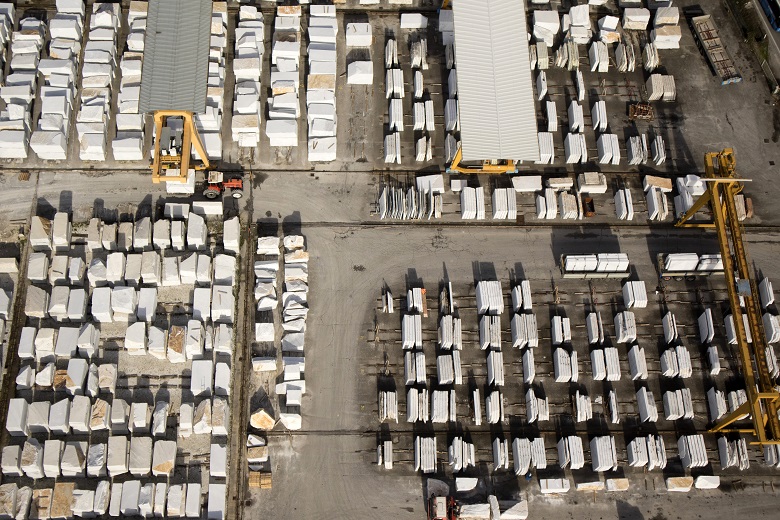



The Chinese economy maintained a positive growth rate during the first half of 2026 (GDP +4.7%), but its momentum slowed noticeably in the second quarter. The imbalance between strong industrial output and weak domestic demand—further burdened by the ongoing real estate crisis and external pressures from geopolitical developments in the Middle East—is redefining the country’s strategy in the international natural stone trade.
1. The Real Estate Crisis Depresses Domestic Demand
According to data from the National Bureau of Statistics of China analyzed by Stonenews.eu, China’s real estate sector continued its structural decline in H1 2026:


-
Floor Space Under Construction: -12.05%
-
New Starts (Floor Space Started): -22.50%
-
Completed Construction (Completed): -24.38%
-
Residential Sales: -15.91%
-
Real Estate Investment: -15.23%
The significant drop in new projects and completions drastically limits the Chinese domestic market’s ability to absorb building and decorative materials, forcing domestic manufacturers to focus even more aggressively on exports.
2. Aggressive Export Strategy: Higher Volume at Significantly Lower Prices
To keep factory operations running, Chinese companies implemented an aggressive pricing strategy in international markets:
-
Processed Marble Exports (H1 2026):
-
Volume: 527,998.50 tons (+15.82% compared to H1 2025, reaching the highest level since 2017).
-
Value: $454.35 million (-26.60%).
-
Average Price per Ton: $860.52 (-36.63%), falling to a ten-year low.
-
This pattern became even more pronounced in the second quarter of 2026, when the value of processed marble exports plummeted by 53.46% and the average price per ton dropped by 44.54%. This trend was directly affected by transportation, energy, and commercial flow disruptions in the Gulf region following escalations in regional conflict, leading to sharp declines in Gulf Cooperation Council (GCC) markets such as Saudi Arabia.
3. Rough Marble Imports: Stabilizing at Lower Levels
On the raw material import side, the Chinese market shows signs of stabilizing at lower levels compared to the historical highs of 2018 (when half-year imports exceeded 4.2 million tons).
-
Rough Marble Imports (H1 2026):
-
Volume: 1,990,740 tons (-0.97%).
-
Value: $569.93 million (+5.38%).
-
Average Price per Ton: $286.29 (+6.41%).
-
The increase in total import value is not driven by higher volume demand, but rather by shifts in the imported material mix and the strengthening of specific premium categories.
4. Supplier Restructuring: The Rise of New Forces
A comparison of the last decade (2016–2026) reveals a profound geographical realignment among supplier countries exporting rough marble to China:
| Supplier Group | Volume Share 2016 | Volume Share 2026 | Value Share 2016 | Value Share 2026 |
| Turkey | 48.14% | 36.99% | 51.67% | 31.44% |
| Italy & Greece | 11.85% | 18.36% | 13.61% | 31.44% |
| Traditional Bulk Flow Suppliers (Egypt, Iran, Spain, Portugal, Pakistan) | 34.10% | 11.30% | 28.80% | 6.60% |
| Emerging Low-Price Asian Suppliers (Cambodia, India, Myanmar, Laos, Vietnam) | 1.00% | 16.20% | 1.00% | 9.30% |
| Emerging Diversified Origins (Namibia, Brazil, Croatia, North Macedonia, Albania) | 0.80% | 11.50% | 1.20% | 15.80% |
Key takeaways by supplier country/region:
-
Italy: Aims for absolute premium value dominance. In H1 2026, Italy accounted for 24.56% of total import value despite representing only 11.41% of volume, with its average price per ton reaching $616.17/ton (+11.08% vs. 2023). It holds an overwhelming majority (86.01%) in the high-end material category above $400/ton.
-
Turkey: Remains the largest supplier by volume (36.99%), dominating the core mass-market price tier between $200–$300/ton.
-
Greece: Faces a constrained picture. Between 2023 and 2026, imported volume dropped by 8.07% and average price declined by 17.95% (to $283.67/ton). Compared to 2021 ($430/ton), the average price of Greek marble in China has fallen by nearly 34%, eroding its previous high-value advantage.
-
Emerging Players (Namibia, Cambodia, India, Croatia): Combined, they surged from a 1.11% volume share in 2016 to 19.43% in 2026. Namibia (104k tons) and Cambodia (155k tons) recorded striking shares—a development often linked to direct Chinese investment in foreign quarries and infrastructure.
5. Impact of Regional Conflicts in the Middle East
The Middle East conflict and logistics bottlenecks around the Strait of Hormuz severely affected imports from Gulf nations during Q2 2026:
-
Rough marble imports from Iran registered zero shipments in June, posting an overall ~91% collapse in Q2.
-
Imports from Oman stopped entirely in April and May, suffering a 94.7% volume drop in Q2.
-
Imports from the United Arab Emirates plummeted by over 70% during May and June.
Conclusion
The Chinese natural stone market is transforming from a massive domestic consumption market into a global hub for processing, transformation, and re-export. With domestic real estate activity remaining sluggish, Chinese importers are operating with far greater selectivity: putting downward pressure on raw material prices, diversifying sourcing across new countries, and channeling vast volumes of finished stone into global markets at extremely competitive prices—exporting market pressure worldwide.