




Securing supply chains for critical raw materials is no longer just a commercial pursuit; it has become a matter of national and economic security for the West. The strategic agreement signed between the European Commission and the United States last April was not the end of the road, but rather the starting point for a new global architecture in mineral markets.
Today, with technical consultations in full swing, this bilateral partnership is transforming into a rigorous framework of controls, pricing, and international alliances that is radically reshaping the global raw materials map. Although natural stones do not belong to the official lists of “critical minerals,” the indirect effects of this alliance are already creating a significant “domino effect” of new regulations and shifts that directly impact quarries and the international trade of marble and granite.


The Memorandum of Understanding and the Action Plan
The initial agreement laid the groundwork for comprehensive cooperation covering the entire value chain: from research, extraction, and processing, to the recycling and recovery of critical raw materials.
However, the element driving long-term momentum is the accompanying “Action Plan for Supply Chain Resilience,” presented jointly by both sides. This plan is not limited to the two sides of the Atlantic; it serves as a “platform” for a broader plurilateral trade initiative involving strategic partners such as Canada, Australia, and Japan.
The 3 Axes Shaping Today’s Agenda
The implementation of the agreement focuses on three critical fronts with a direct impact on the global market:
-
Economic Defense Against Dumping: At the heart of current negotiations is the establishment of price protection mechanisms, such as border-adjusted price floors. The goal is to protect Western mining investments from the practices of artificial oversupply and price suppression historically used by China to eliminate competition.
-
Strict Traceability and ESG: The EU and the US are aligning their regulatory frameworks. The implementation of the new EU Forced Labour Regulation, combined with American enforcement controls, now obliges companies to fully map their supply chains. Any mineral linked to environmental degradation or human rights violations will be barred from entering these two major markets.
-
Subsidy Coordination and Joint Investments: To prevent distortions in competition between them, Brussels and Washington are establishing a joint framework for mapping state aid, while promoting co-investing in high-impact industrial projects.
What Does the Agreement Mean for the Global Natural Stone Sector?
As these rules solidify, the international stone market is being catalytically affected through three main channels:
-
Reshaping Global Trade: This strategic partnership reinforces the West’s climate of economic protectionism. The US has already imposed high anti-dumping tariffs (up to 50%) on imports of natural granite and, more importantly, engineered quartz surfaces from major global players like Brazil and India. This forces American importers to seek alternative, stable natural stone markets in Europe.
-
The ESG Regulatory “Wave”: The strict traceability checks and crackdown on environmental degradation agreed upon by the EU and the US set a horizontal precedent for all extractive industries. Marble quarries worldwide—from Italy and Spain to Turkey and Asia—are now required to adopt strict and often costly sustainability standards to maintain seamless access to Western markets.
-
Green Transition in Quarries: The tightening of environmental legislation (such as the upcoming implementation of the ETS2 system in Europe for carbon emissions) increases operational costs, pressuring the natural stone industry globally to invest immediately in the decarbonization of transport and equipment.
The Geopolitical Chessboard and Surging Demand
The urgency to activate these mechanisms is reflected in the latest data from international organizations like UNCTAD. With the transition to green energy and clean technologies accelerating, global demand for lithium is projected to skyrocket by 353% and for graphite by 131% by 2040.
This pressure moves the diplomatic battle directly onto the field of reserves. A characteristic example is Norway, which, due to its vast mineral deposits, is at the center of attention for both the EU and the US, as both sides seek to “lock in” their own supply streams.
Conclusion
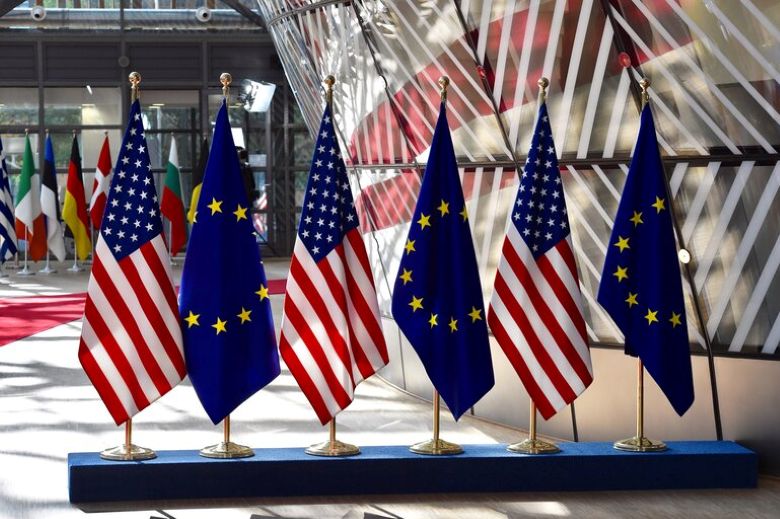
What began in April as an official photo opportunity and a memorandum signing in Brussels is now evolving into a profound structural shift in global trade. For the extractive and raw materials sector, the EU-US partnership is not just a political declaration; it is the new rule of law that will define investments, prices, and corporate alliances for decades to come.
For companies operating in extraction and processing, the tightening of trade relations between the two sides of the Atlantic establishes a new framework for international supply chains, tariff policies, and sustainability standards.
Supply Chain Stabilization and Trade Facilitation
The agreement comes during a period of heightened uncertainty for global trade, fueled by geopolitical tensions and disruptions in maritime transport. By institutionalizing a cooperation framework, the EU and the US aim to reduce reliance on third countries and secure the seamless flow of raw materials.
This shift toward creating secure, regional trade corridors (friend-shoring) may indirectly benefit other extractive products. For sectors with a strong export orientation toward the American market, such as the European natural stone and marble industry, the strengthening of bilateral economic channels could pave the way for the reduction of bureaucratic barriers and the stabilization of logistics costs.
Shared Sustainability Standards and ESG
A central pillar of the EU-US partnership is the commitment to strict environmental, social, and governance (ESG) criteria throughout the extraction process. The adoption of common standards for sustainable resource management and carbon footprint reduction will not be confined to critical minerals alone.
European companies, which already comply with the EU’s stringent regulatory framework, gain a comparative advantage in the US market over competitors from regions with lower environmental standards. Certifying the sustainable origin of materials is rapidly becoming an essential passport for international markets.