




Through an international educational programme developed in collaboration with YACademy, Franchi Academy brings young architects into direct contact with Carrara marble, connecting knowledge of the production process with contemporary architectural approaches, design and sustainability.
Over the past three years, Franchi Academy has developed a framework for education and knowledge exchange that places Carrara marble at the centre of a dialogue with leading figures in contemporary architecture. The approach considers natural stone not simply as a finished product, but as a material with a specific geological origin, technical characteristics, production history and a broad range of potential applications.


The collaboration with YACademy, an educational organisation connecting young architects with international architectural practices and leading companies, has played a decisive role in the initiative’s development. Together, the two organisations have established a platform for applied research, combining in-depth knowledge of marble, from quarrying to processing, with the requirements of contemporary architectural design.
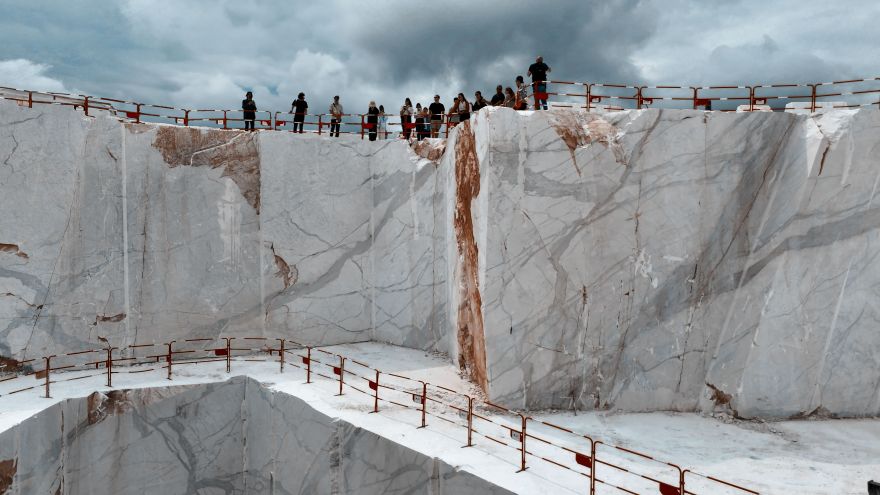
Through courses and workshops, participants gain first-hand experience of the material in the places where it is quarried and processed. Direct contact with the production chain brings factors such as the properties of stone, processing techniques, certifications and sustainability into the design process.
International Architecture Practices at the Centre of the Programme
The participation of architects from practices including Snøhetta, BIG, AMDL Circle, Zaha Hadid Architects, Herzog & de Meuron and EMBT Miralles Tagliabue has broadened the scope of the Academy’s programme. Other contributors have included figures such as Giuseppe Zampieri and Claudio Silvestrin, bringing different perspectives to the relationship between marble, architecture, landscape and design.
One of the notable workshops was Carrara Community Quarry, led by Patrick Lüth of Snøhetta. The programme explored the relationship between quarries, landscape and community, examining how a quarry can serve as a starting point for broader architectural investigation. This approach reflects the practice’s design philosophy, also evident in the Oslo Opera House, where Carrara white marble covers the accessible roof, creating a public space overlooking the fjord.
A different perspective emerged from From Quarries to Temples, a workshop involving Giuseppe Zampieri, partner at David Chipperfield Architects Milan and director of the Franchi Academy master’s programme. Participants were invited to explore the possibility of creating an interfaith meditation space within the Ravalunga quarries. The exercise focused on proportion, permanence and the relationship between architecture and its setting.
Giulio Rigoni of BIG – Bjarke Ingels Group introduced another dimension, examining the connections between marble, urban scale, narrative and collective experience. Through the Bucce project, marble was approached as an active material capable of establishing new relationships between objects, spaces and architectural narratives.
Similarly, Nicholas Bewick of AMDL Circle contributed to the Transcendence and Design module, which explored the relationship between marble, design and spirituality, focusing on ritual objects and their role in sacred spaces.
Discussions with Bogdan Zaha of Zaha Hadid Architects and Olga Bolshanina of Herzog & de Meuron examined the connections between architecture, fashion, retail, design, material textures and spatial perception. Benedetta Tagliabue of EMBT Miralles Tagliabue brought a perspective centred on the relationship between architecture, landscape, the memory of places and the sensory qualities of materials.
Claudio Silvestrin, a leading figure in international minimalism, highlighted the importance of natural stone as an essential component of architectural composition rather than merely a cladding material. His approach focused on marble’s ability to shape proportion, light and the perception of space, while emphasising the need for knowledge and careful use of the material.
The Master in Spiritual Architecture and New Approaches to Marble
The launch of the Master in Spiritual Architecture in 2025 marked an important milestone for Franchi Academy. The programme placed Carrara marble at the centre of an international discussion on the relationship between architecture, materiality and spirituality.
The exploration of sacred, contemplative and symbolic architecture offers a different framework for understanding natural stone. Within this context, the significance of the material extends beyond its technical and aesthetic properties to include its contribution to the experience of a space.
Through its educational collaborations and workshops, Franchi Academy seeks to bring architects into direct contact with the material before they encounter it as a finished product. Quarries, slabs, natural veining, processing techniques and knowledge of the production chain thus become integral elements of the design process.
The partnership with YACademy reinforces this approach, connecting Carrara’s production expertise with developments in international architectural education. For the natural stone industry, the initiative highlights the value of introducing emerging architects to the origins, capabilities and limitations of stone as part of a more comprehensive approach to material selection and its application in architecture.
Source: Franchi Academy – company presentation published in TOP SPEAKING