





In the United States, homeowner spending for improvements and maintenance is expected to slow gradually through 2026, according to the latest Leading Indicator of Remodeling Activity (LIRA) from Harvard University.
Market Trends Through Late 2026
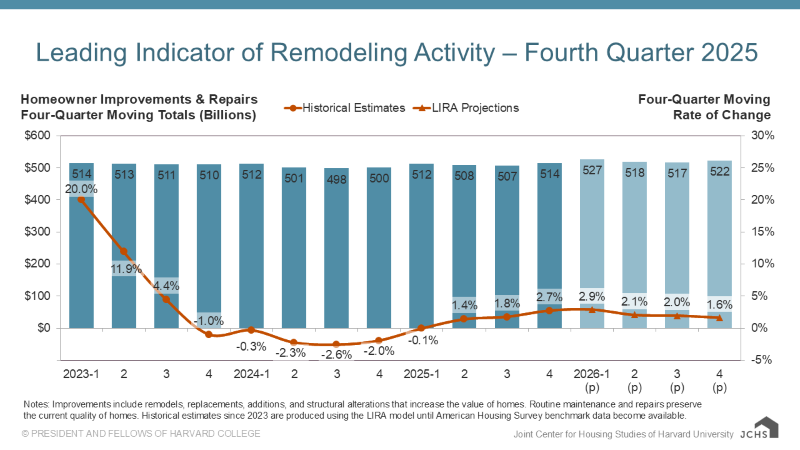
The Remodeling Futures Program analysis projects that year-over-year growth in renovation and repair spending will reach 2.9% early this year, before easing to a more modest 1.6% growth by the end of 2026.


Total Spending Volume Remains Robust
Despite the deceleration in growth rates, the overall market volume remains impressive. Rachel Bogardus Drew, Director of the Remodeling Futures Program, noted:
“Single-family home sales and permitting activity have picked up modestly from very low levels, which should support a nominal increase in remodeling activity this year. Even with some deceleration later in the year, overall annual homeowner spending on improvements is expected to reach $522 billion by the end of 2026.”
Chris Herbert, Managing Director of the Center, highlighted the strong connection between the remodeling market and the broader US economy:
-
Interest Rates: If rates begin to ease, a much-needed boost is expected for both housing construction and retail sales of building materials.
-
Challenges: For now, high borrowing costs and material prices continue to pose significant headwinds to homeowner improvement spending.
Significance for the Marble and Stone Industry
The strong home improvement market affects not just the construction sector but also the natural stone industry.
For companies exporting natural stone to the U.S., the forecasted $522 billion in homeowner spending indicates that demand remains robust, despite the slower growth rate. The American market continues to act as a “benchmark” for luxury materials such as marble and granite, as homeowners continue to invest in enhancing their property value.
Note: Due to delayed and missing data resulting from the 2025 federal government shutdown, adjustments were made to the January 2026 LIRA methodology. Cleveland Fed’s Revised 16% Trimmed Mean CPI was applied for October 2025, and standard imputation methods were used for November 2025 housing starts. Actual December values from the National Association of Realtors (NAR) were used for existing home sales.