




Italian exports to Riyadh have surged by 216% over the past five years, as Carrara marble and other natural stones from Italy become a hallmark in Saudi Arabia’s Vision 2030 projects, highlighted at Marmomac 2025.
In Saudi Arabia, the future is taking shape in Italian stone. Vision 2030, the mega-projects of NEOM and Qiddiya, Expo 2030 in Riyadh, and the FIFA World Cup 2034 have transformed the country into the largest construction site in the world. Here, demand for high-end materials continues to grow, fueled by real estate and infrastructure investments that exceeded $1.06 trillion in 2024.


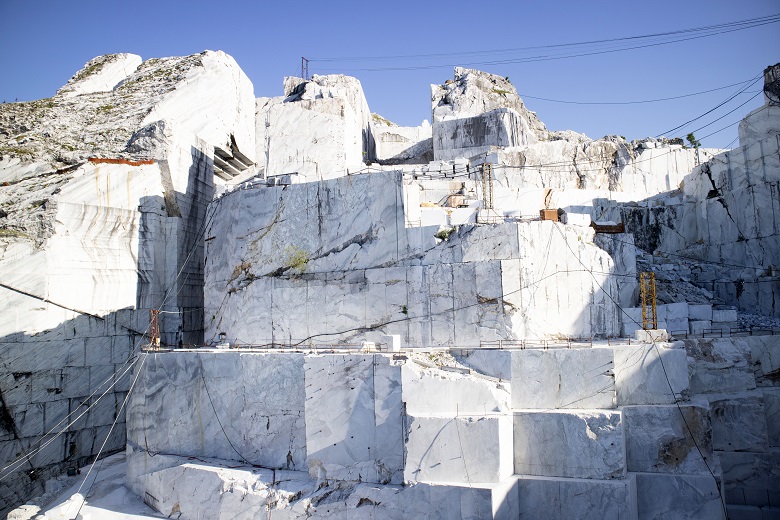
Within this context, Italian marble has found a privileged position. The latest research by Nomisma, commissioned by Marmomac, confirms this trend: imports from Italy to Saudi Arabia have increased by 216% in the last five years, making Riyadh the main hub of demand in the Arabian Peninsula, accounting for 47% of total imports.
Explaining the nature of this growth is architect Amedeo Schiattarella, a finalist in the “Speciale Marmomac” category of the international Dedalo Minosse award. For over fifteen years, he has worked closely with Saudi clients. His studio’s projects range from the digital art museum inaugurated in December 2024, to an urban park under construction in Riyadh with Milanese studio Gruppoland, to a new ministerial building in the city center, as well as a monumental intervention planned this year at a historic city site.
“Many recent projects have been ‘colonized’ by Western models, imposing designs foreign to the context,” says Schiattarella. “We have chosen a Saudi path to contemporary architecture, emphasizing local culture and traditions.” One notable example is a competition for a skyscraper in Riyadh: instead of the vertical monolith requested in the brief, his studio proposed a “horizontal skyscraper,” porous and permeable, interweaving public and private spaces, and reflecting the organic nature of the city.
In this approach, stone takes center stage: local stone is crafted to “vibrate” and reveal its depth, while Italian marble—particularly Carrara—is used as a distinctive element in interiors, enhanced by textures and striations that emphasize its materiality. “Italy enjoys an extremely high reputation,” Schiattarella adds, “linked to the ideas of quality, culture, and design expertise.”
These three dimensions are showcased at Marmomac 2025, ongoing until tomorrow at Veronafiere, offering an ideal stage where natural stone and Italian processing technologies are presented to buyers, architects, and designers from nearly 150 countries.