




Driven by an ambitious state-led housing program, Algeria’s construction market is expanding steadily, offering strategic prospects for international stone suppliers and processing machinery manufacturers.
Recent data released by the National Office of Statistics (ONS) confirms a sustained positive trend for Algeria’s construction market, with an estimated growth of 4.1%. This momentum highlights the sector’s strategic weight within the North African nation’s broader economy and signals expanding commercial avenues for the global natural stone value chain.


Government Housing Initiatives Drive Market Momentum
The primary engine behind this growth is the residential segment, underpinned by extensive public housing programs managed by the AADL (Agence Nationale de l’Amélioration et du Développement du Logement). This strategic urban development framework has yielded significant figures:
-
Over 1.7 million housing units were initiated during the 2020–2024 period.
-
Approximately 250,000 new dwellings broke ground in the first half of 2025 alone.
-
A long-term target of 2 million homes is set for completion by 2029.
Projections indicate a stable trajectory for the Algerian construction sector over the next four years, maintaining an average annual growth rate of 4.2%.
Industry Insight:
This large-scale residential expansion generates substantial, long-term demand for building materials, interior finishes, cladding, and flooring—segments where natural stone traditionally holds a competitive advantage.
Italy as a Benchmark: Export Dynamics and Technology Transfer
Algeria represents a high-priority market for European suppliers, particularly the Italian stone and machinery ecosystem. Italian exports of natural stone and complementary technologies to the country reached $17.5 million.
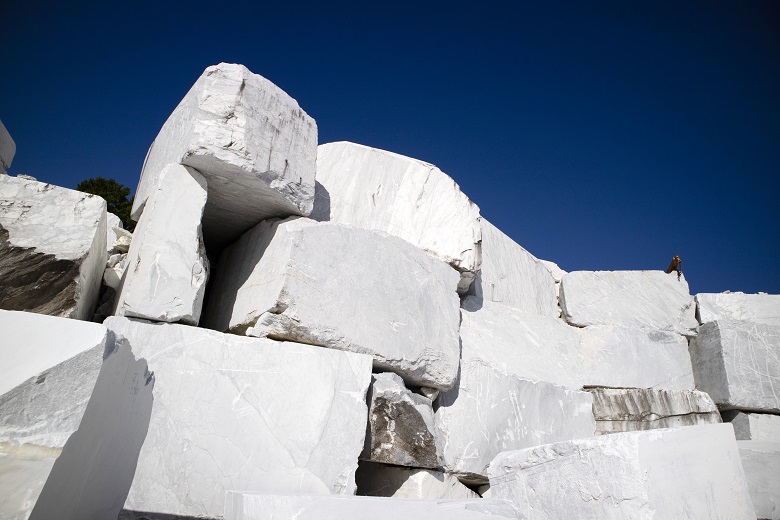
While finished marble and granite find placement in high-end projects, the modernizing Algerian market is increasingly focused on processing technologies and machinery. As local infrastructure develops, domestic enterprises are actively seeking to upgrade their quarrying and processing capacities. Consequently, the demand for advanced stone-working machinery presents a significant opening for international manufacturers aiming to support Algeria’s domestic production capabilities.