

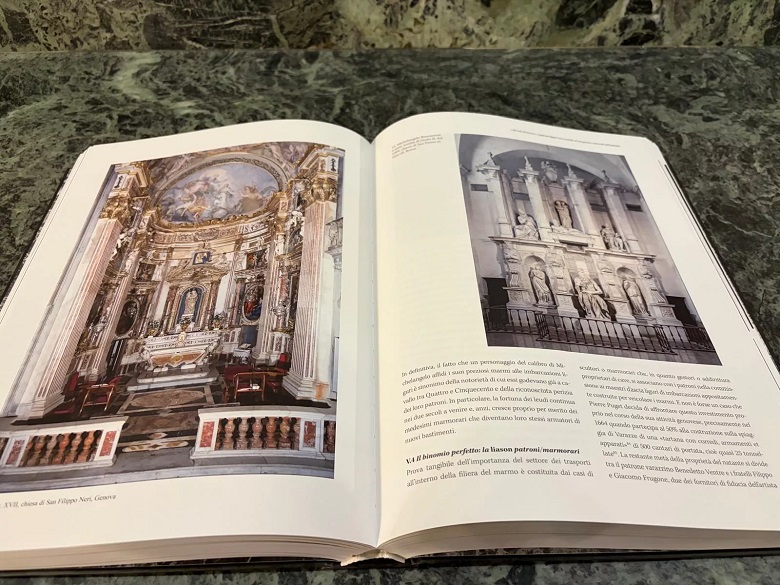



The history of Genoa in the seventeenth and eighteenth centuries is usually told through its financial power and its bustling port, a crucial crossroads of the Mediterranean. Much less known — almost hidden in archives and specialist studies — is the remarkable story of the rise of a true Republic of Marble: a vibrant and well-structured economic community that transformed the city into one of Europe’s leading centers for marble craftsmanship and trade. This surprising chapter is brought to light by Roberto Santamaria in his book Marmor nostrum in Mare Nostrum. Genoa and the Rise of a Republic of Marble in the Early Modern Age, the result of decades of archival research and previously unpublished findings.
A systematic reconstruction without precedent
The book represents the first major comprehensive reconstruction of the history of Genoa’s marmorari — marble workers — in the Early Modern period, a world still little explored outside narrow academic circles. Santamaria, a researcher at the State Archives, traces in detail the birth and evolution of a true economic community revolving around marble: stonecutters, quarrymen, transporters, merchants and entrepreneurs who, over time, built an international network linking quarries, ports, artistic workshops and monumental construction sites.


What emerges is a portrait of the Genoese marble workers not merely as artisans, but as protagonists of a complex production chain requiring technical skill, organizational ability and entrepreneurial vision. It was a solid and dynamic system that contributed decisively to the urban and cultural development of the city.
When even Michelangelo looked to Genoa
To underline Genoa’s importance in the marble trade, Santamaria and the speakers at the book’s presentation recall emblematic episodes. One of them, mentioned by Luigi Attanasio, president of the Genoa Chamber of Commerce, concerns Michelangelo himself.
In search of an efficient way to transport marble blocks from Carrara to the construction site of St. Peter’s, the artist turned to Genoese sailors and technicians. In the leudi, the city’s characteristic vessels, he found the perfect solution to avoid damaging the precious stone. This anecdote is a vivid reminder of how advanced Genoa’s maritime and logistical expertise already was.
The presentation of the book also forms part of the broader preparations for the 500th anniversary of the Republic of Genoa, an occasion that aims to highlight many lesser-known aspects of the city’s heritage.
Genoa as a Mediterranean hub of innovation
Santamaria’s volume illustrates how, in the Early Modern era, Genoa acted as a strategic center of exchange, expertise and innovation in the Mediterranean. The marble industry shaped not only the local economy but also artistic and architectural styles that spread across Europe.
The ability of the marmorari to specialize, move between regions, build international networks and engage with distant markets anticipates traits of modern entrepreneurship. Through their story, Santamaria offers a fresh perspective on the social dynamics and guild systems of the period, showing how Genoa’s marble sector provides a unique lens through which to interpret long-term economic transformations.
Source: www.primocanale.it