


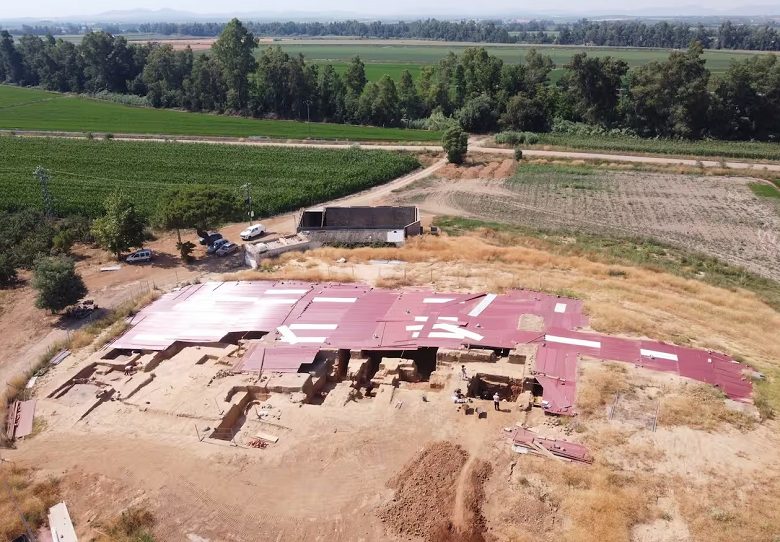



A remarkable archaeological discovery was brought to light during the seventh excavation campaign at the Casas del Turuñuelo site in Spain, under the direction of Esther Rodríguez González and Sebastián Celestino Pérez. The find once again confirms the significance of the Tartessian culture (8th–5th century BCE) in shaping the cultural map of the western Mediterranean.
On July 3rd, the lead archaeologists presented the results of this year’s campaign, unveiling an exceptionally rare find: a pristine white marble column, likely part of an ancient Greek altar — the oldest of its kind ever found in the western Mediterranean.


A Marble Trace of Hellenism in Tartessos
The column, along with its base and shaft, was analyzed by Anna Gutiérrez of the Catalan Institute of Classical Archaeology (ICAC). Her analysis revealed that the object originates from the Marmara region of Asia Minor, a part of the Greek world during the 5th century BCE. While archaeometric analyses are still underway, its composition appears to be pentelic marble — a fact that makes the find truly unique.
The presence of such a refined and far-traveled material in the Iberian hinterland — rather than a coastal site, where Greek artifacts are more commonly found — supports the theory of extensive trade and cultural networks in the region during the Tartessian Period. Its association with Attic-style cups, ceramics, and other ritual artifacts suggests that the object likely formed part of a Greek-influenced altar.
Rituals and Know-How in a Prehistoric Settlement
The marble column was not found in isolation. The same archaeological layer also contained Attic-style ceramic vessels, a bronze potter’s wheel, and evidence of ritual activity — such as the mass animal sacrifices discovered in 2017 — all attesting to the religious importance of the site.
Yet, beyond its ritual role, the site also reveals the technological sophistication of its inhabitants. This year’s excavations uncovered six new spaces, three of which are open-air and connected to productive activities — including kilns, loom weights, mills, and storage ceramics, all indicative of highly specialized craftsmanship.
One particularly striking discovery was a hydraulic structure nearly one meter tall, which appears to have been planned before the main building was constructed. The foresight and technical precision of the builders have impressed archaeologists, who view such features as evidence of advanced architectural understanding and the needs of a well-organized society.
Greece in Iberia – Cultural Traces and New Perspectives
The Greek column made of pentelic marble joins earlier discoveries from the area — such as Macedonian-origin glass and remnants of another sculpture carved from the same type of marble — strengthening the theory that the Casas del Turuñuelo functioned as a major ritual and redistribution center.
As Sebastián Celestino Pérez explains, the presence of such exotic and culturally charged objects reveals the complexity of the site, which seems to have combined political power, economic prosperity, and religious activity. The fact that these elements coexisted in a location far from the sea transforms our understanding of how ancient peoples connected across vast distances.
This discovery is not merely a treasure for Spanish archaeology, but a fascinating new chapter in the history of the ancient Mediterranean. The Greek column of Tartessos is not just an artifact of art; it is a symbol of cultural fusion and a testament to how Greece — both as an idea and as a material culture — deeply influenced the known world.