


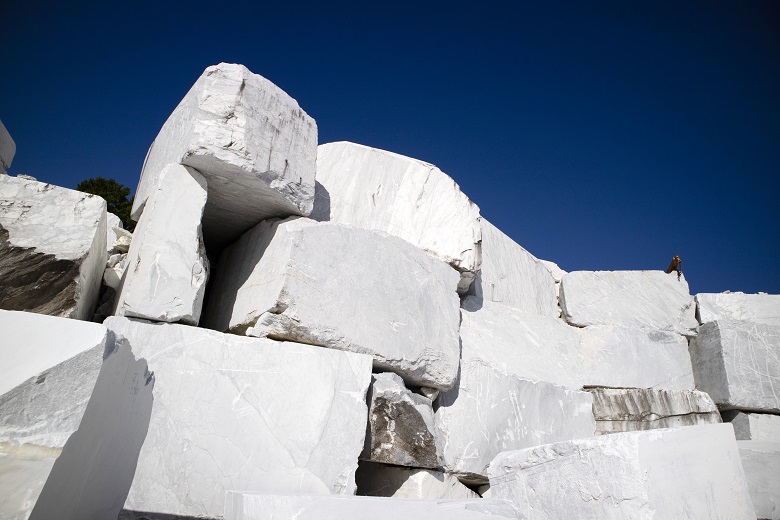



According to a Stonenews study, China’s raw marble market shows stabilization and adaptation to a new production model in the first nine months of 2025. Despite a slight economic slowdown in the third quarter, China remains the largest consumer and processor of marble and granite globally.
The Chinese economy grew by 5.2% GDP, with industrial output up 6.2% and the services sector increasing 5.4%. The slowdown in Q3, influenced by trade tensions with the United States, reflects the need to adjust strategies toward domestic demand and exports.


Structural Challenges and Marble Demand
The raw marble sector is directly affected by the ongoing slowdown in real estate. Falling construction starts, declining housing sales, and reduced investments limit the demand for raw materials, putting pressure on natural stone industries. The Stonenews study notes that after a period of strong growth from 2015–2020, the real estate market entered a deep correction between 2021–2025, with investments falling approximately –12% in 2025.
This reduced domestic demand has led producers to redirect raw marble primarily toward export-oriented processing rather than internal consumption.
Imports and Exports of Raw Marble and Granite (2015–2025)
The Stonenews analysis shows:
-
2015–2019: High imports driven by strong construction activity, with annual growth sometimes exceeding 20%.
-
2020–2025: Gradual decline, with 2025 recording the lowest quantities and values of the decade.
Specifically:
-
Marble imports: from $1.44B (2021) to $856M (2025), quantities from 5.1 to 3.14 million tons.
-
Granite imports: $604M, average price per ton $145.9, the lowest of the decade.
The drop in prices and stable quantities indicate a shift toward higher-quality, export-oriented use of raw materials.
New Production Model: From Domestic Demand to Export Orientation
The decade 2015–2025 reflects China’s transition from a domestic-market focus to a more export-oriented and technologically advanced production model:
-
Imports decrease, while processed product exports remain resilient or increase.
-
The ratio of exports to imports rises, signaling a shift toward higher value-added production.
China now operates as a global hub for marble processing and trade, leveraging technical expertise, production capacity, and advanced logistics.
Supplier Diversification
The last decade has seen a diversification of China’s raw marble suppliers:
-
2015–2019: Dominated by Turkey, Greece, Egypt, and Pakistan.
-
2020–2025: Strengthened relations with Africa (Namibia, Angola, Zambia, Kenya, Tanzania, South Africa), Asia (India, Myanmar, Laos, Vietnam, Oman), and Oceania (Australia).
The strategy balances maintaining relationships with traditional, high-quality suppliers and expanding ties with emerging markets, enhancing the quality of the import mix.
Conclusions
The Stonenews study shows that China’s raw marble market has reached a mature phase of rationalization:
-
Focus on quality and efficiency over volume.
-
Shift toward export orientation and value-added production.
-
Supplier diversification and import mix upgrade.
China remains a key global player in the marble industry, with a strong production and technological base capable of shaping international market trends.