

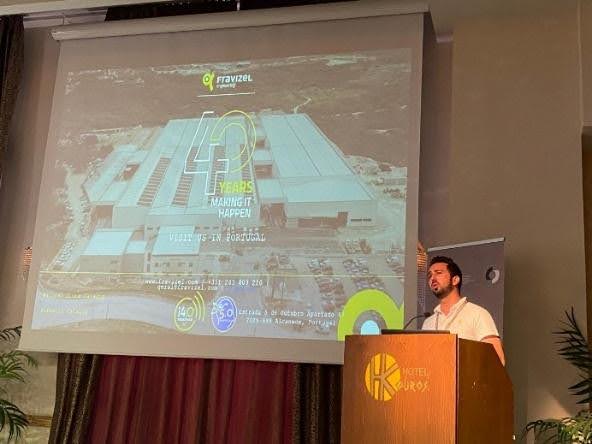



Fravizel participated in the 8th edition of the Global Stone Congress, held from June 16 to 20, 2025, in the city of Drama, Eastern Macedonia, Greece. The event brought together experts and professionals from various countries to discuss topics related to geoscience, the stone industry, and innovation in the sector.
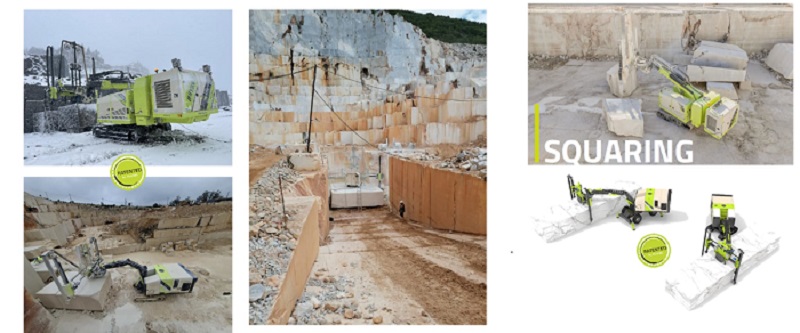
During the conference, Fravizel presented its vision on sustainability and decarbonization in a technical session dedicated to “Green Technology” in the natural stone industry. The company highlighted a technology called ELECTRA (diamond wire machine to square the bench) that can reduce carbon dioxide (CO₂) emissions by up to 90% and the cost up to than 60% (depending in operational conditions).


 With 40 years of history, Fravizel develops and manufactures sustainable innovation (social, economic, and environmental) for the extractive sectors. It has a factory are of more than 34,000 m2 and a team of more than 130 people. It has more than 90 intellectual property processes and won the COTEC SME Innovation Award in 2024.
It seeks to facilitate the operator’s work by providing good conditions, safety, and technological attractiveness for the work (social sustainability). It advocates innovation as a lever for good time management and productivity (economic sustainability). It promotes the circular economy and hybrid technology (environmental sustainability).
Fravizel has invested heavily in the decarbonization of the extractive industry, developing solutions that enable productivity gains, energy efficiency, and carbon emission reductions, in line with the goals of the European Green Deal. The company has developed machines with hybrid technology that improve worker safety, increase productivity, and reduce the carbon footprint.
The Green Deal’s goals (reducing emissions by 55%) present an opportunity, allowing us to achieve what was previously unthinkable. Some of the stone sector’s main challenges are sustainable sourcing, environmental footprint, digitalization, and safety. This is a sector that, when competing with its product for large projects, gains competitive advantages by demonstrating reduced CO2 emissions on the BIM (building information model) platform. Productivity gains, decarbonization, digitalization, and increased efficiency in transporting only what is needed to other production units where the stone is processed are key factors for the sector’s competitiveness. Stone presents a unique opportunity for a sustainable product because it is durable and can be presented as one of the most sustainable in the construction value chain if extracted with economic, environmental, and social efficiency.Fravizel believes the recipe for decarbonization lies in efficiency (executing quickly), cost reduction, product valorisation, and circular economy.