






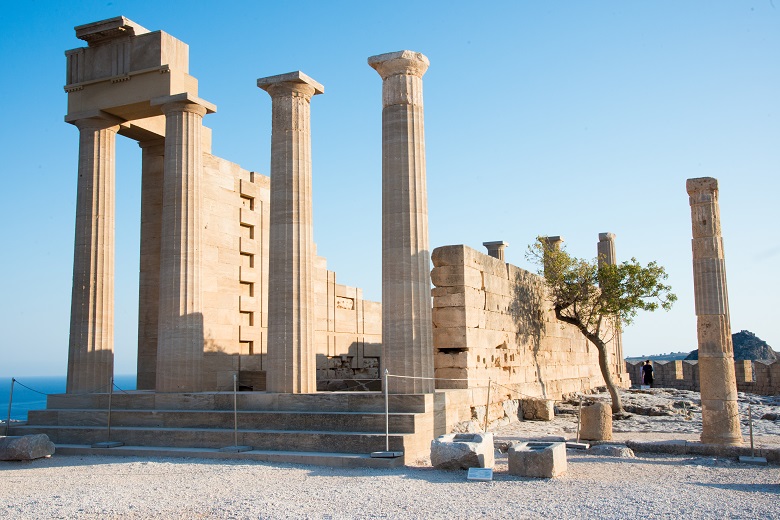
The Acropolis of Lindos, perched on a rocky outcrop 116 meters above sea level, dominates the southeastern coast of Rhodes. It uniquely combines ancient Greek, Hellenistic, and medieval architectural heritage. Its strategic position made it, from antiquity, a center of governance, worship, and military power.
Historical Evolution and Stratification
The Acropolis’ history spans more than two millennia, with successive construction phases reflecting Rhodes’ political and cultural transformations:


-
Archaic period (6th–5th century BC) – The Temple of Lindian Athena stood as the principal sanctuary of the city-state, dedicated to its patron goddess. Built from local limestone, it combined Doric features with adaptations to the island’s climatic and geological conditions.
-
Classical and Hellenistic periods (5th–1st century BC) – Lindos flourished as a major commercial and naval hub. Monumental staircases, propylaea, and stoas were added, showcasing precise stone-carving techniques that took advantage of the limestone’s workability.
-
Roman era – The Romans incorporated Lindos into their trade network, maintaining Hellenistic structures and adding functional constructions using local stone and Roman mortar techniques.
-
Medieval period (14th century) – The Knights Hospitaller transformed the Acropolis into a fortified stronghold. Walls and towers were reinforced with volcanic stone and limestone, using masonry designed to resist moisture and strong winds.
Architectural and Technical Features
The Acropolis serves as a living “manual” of ancient and medieval stonemasonry:
-
Materials – Predominantly local limestone, valued for its durability and ease of carving, with volcanic stone used mainly for strengthening defensive walls.
-
Techniques – From early dry-stone fortifications to large, finely dressed ashlar blocks laid without mortar, the Acropolis illustrates the evolution of Mediterranean masonry.
-
Spatial layout – The arrangement of sanctuaries, fortifications, and terraced pathways demonstrates expert adaptation to the natural terrain and the dual role of the site as a religious and defensive center.
Cultural and Historical Heritage
Today, the Acropolis of Lindos is a protected archaeological site and is internationally recognized for its exceptional cultural value:
-
Multilayered history that reflects the interaction of Greek, Roman, Byzantine, and medieval cultures.
-
Architectural continuity, where stone was adapted to the needs of each era without losing the site’s original character.
-
Technical excellence, allowing large sections of the structure to remain in good condition despite exposure to harsh coastal weather conditions.
Contemporary Significance
The Lindos Acropolis remains a valuable reference point for archaeologists and stone conservation specialists, as it demonstrates long-term durability without extensive modern intervention. It stands as a living reminder that stone is not merely a building material but also a carrier of history and identity.