

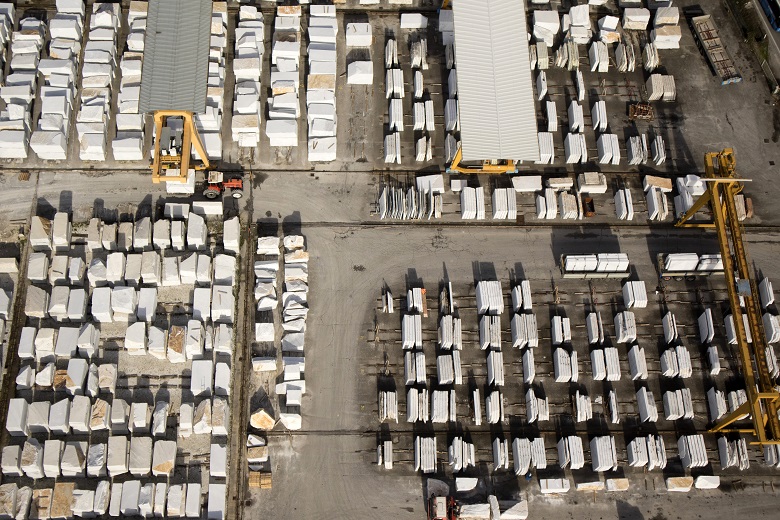



Turkey’s marble exports demonstrated notable resilience during the first half of 2025, reaching USD 871.8 million and 2.5 million tons. Compared to the same period in 2024, export value increased by 4.1%, despite a 4.1% decline in volume. This outcome highlights the ability of Turkish companies to strengthen their presence in international markets even during challenging times.
Shift Towards Processed Marble
Analysis of the product mix shows a clear shift towards processed marble, which continues to gain ground over raw blocks and slabs. This development reflects the upgrading of Turkey’s export profile, enhancing revenue from higher value-added products.


In contrast, exports of raw marble continue to decline. The first half of 2025 saw further decreases in both value and volume, confirming the long-term contraction trend observed since 2021. Despite relatively stable average prices, Turkish companies are increasingly relying less on raw marble for their export activities.
China remains the largest destination for raw marble, but it has shown a consistent decline in imports from Turkey. Between 2021 and 2025, the value of shipments fell by approximately 53%, and volumes decreased by 57%, while the average price saw only a slight increase. This decline largely explains the overall contraction in Turkey’s raw marble exports in recent years.
Growth in Processed Marble
Exports of processed marble strengthened during the first half of 2025, reaching USD 630.5 million and 1.24 million tons. Compared to 2024, value rose by 10.3%, while volumes remained almost unchanged (+1.2%).
This growth is primarily linked to an increase in the average price, which for the first time exceeded USD 500 per ton. Despite this progress, Turkish prices remain lower than those of competing countries, with the increase largely attributed to high extraction and production costs, further exacerbated by Turkey’s high inflation.
The United States continues to be the largest market for processed marble, with imports rising in both value and volume, surpassing 2021 levels. Demand from France remained stable, while Middle Eastern markets, including Iraq and Saudi Arabia, showed more volatility, recording declines in both value and volume.
Conclusion
The performance of Turkey’s marble exports in the first half of 2025 confirms the ability of companies to adapt to changing conditions and enhance their export profile. The shift towards processed products and the growth of high-value markets underscore the strategic importance of diversification and the development of higher value-added products.