




The first half of 2025 in the United States unfolded in a highly uncertain environment, both macroeconomically and commercially. Despite these pressures, the processed marble market showed remarkable resilience, maintaining its premium character and consolidating Italy’s and Turkey’s positions as the two main suppliers in the U.S. market.
Macroeconomic Context: Fed on Hold, Early Signs of Slowdown
Throughout H1, the Federal Reserve kept the key interest rate at 4.25%–4.50%, adopting a wait-and-see approach as inflation gradually declined and the labor market showed early signs of softening. By late summer, weaker employment indicators reinforced expectations for rate cuts starting in September.


Tariffs and Trade Adjustments
The trade environment was highly volatile, with successive tariff announcements creating uncertainty around cost and planning. Many companies engaged in forward-ordering in Q1 to preempt rising tariffs. In Q2, strategies diversified by product and supply chain, reflecting adaptation efforts amid ongoing uncertainty from April tariffs (up to 125%) and the partial May suspension (10%).
Construction Activity: Selective Demand and Material Trends
Construction activity was uneven. Residential projects declined due to high financing costs (–2.66%), while non-residential segments, like offices, recorded positive growth (+4.06%). Overall, private construction fell –1.44%, with building permits and projects under construction down –3.60% and –14.45%, respectively.
In building materials, notable trends included:
-
Marble: +7.49%
-
Granite: –10.46%
-
Ceramics: +2.37%
-
Concrete: +3.47%
-
Cement: –2.99%
Marble clearly stands out as the most resilient material of the period.
Processed Marble Imports: Premium Resilience
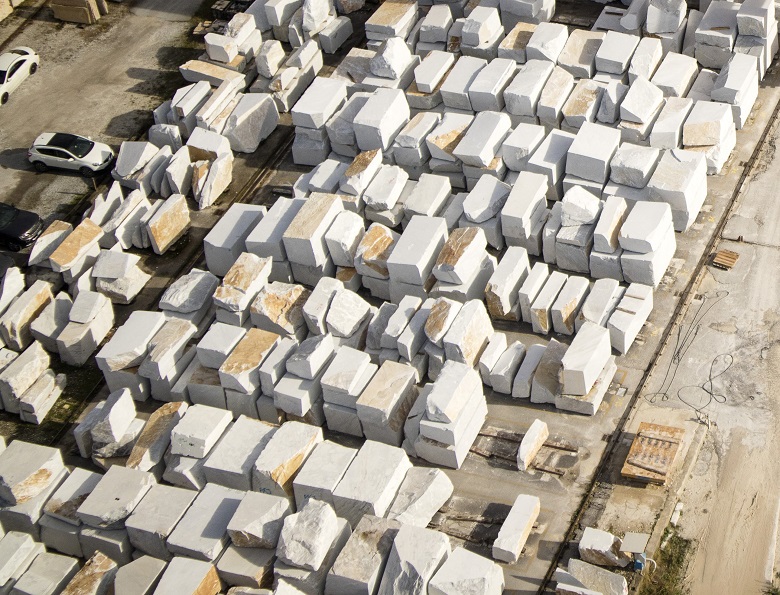
U.S. processed marble imports reached $615 million, the second-highest value of the decade, with quantities exceeding 583,000 tons. The average price of $1,055/ton underscores marble’s premium status, maintaining demand even under high cost conditions.
Granite continued its decline, with imports at $333 million and 450,000 tons, the lowest decade-level performance. High average prices ($739/ton) indicate retention of only the highest-quality products. Ceramics maintained leadership in volume (1.74 million tons) and value ($1.10 billion), with a clear shift toward higher-value categories.
Suppliers: Italy and Turkey Dominate
The U.S. market shows a bipolar structure:
-
Turkey: Dominates in volume (50.8% of quantity) and 28.9% of value. Favorable tariffs (+10%) and the weakened lira enhance competitiveness.
-
Italy: Leads in value (34.2%) and gains in quantity (11.6%), confirming its position as a premium supplier despite 15% EU tariffs and negative EUR/USD exchange impacts.
Other countries show limited or declining roles:
-
China: Historic low (10.8% value, 10.1% quantity) due to high tariffs (125%).
-
India: Stable (~7% value, 9–10% quantity).
-
Brazil: Declining (4.2% value, 3.3% quantity).
-
Greece: Small but consistent (~2% value, 1.4% quantity).
-
Mexico: Decreased after 2024 peak (6.4% quantity, 5% value).
Tariffs and Legal Developments
New tariffs implemented in August–September 2025 created additional uncertainty. On August 29, 2025, the Federal Circuit ruled that “Liberation Day tariffs” may have exceeded presidential authority under IEEPA, opening a path for Supreme Court review in November. Until then, tariffs remain in effect, affecting costs and import planning. A potential annulment could require refunds and strategic adjustments, while upholding them would establish a precedent for more direct tariff use.
Conclusion: A Market in Transition
H1 2025 confirms that, despite economic and trade uncertainty, the U.S. processed marble market remains resilient. Marble maintains its high-value appeal, granite continues to decline, and ceramics retain volume with quality upgrading. Italy and Turkey now define market structure, with other countries playing peripheral roles.
H2 2025 will be critical, as Supreme Court decisions on tariffs and potential Fed rate cuts will determine whether current resilience evolves into growth or stabilizes into consolidation.