





A remarkable discovery has come to light in the ancient Etruscan city of Vulci: a marble head of a Greek Kore, presented on December 5 in the Sala della Crociera at the Ministry of Culture in Rome. The find, made during excavations carried out as part of the “Vulci Cityscape” project by the Universities of Freiburg and Mainz, represents a rare example of Greek Archaic sculpture in Etruria, illuminating the deep cultural and artistic connections between ancient Greece and pre-Roman Italy.
 The marble head, attributable to an Attic workshop from the early 5th century BCE, depicts a young woman with an elaborate hairstyle, reflecting the elegance and technical mastery of Archaic Greek sculpture. This discovery highlights Vulci’s role as a crossroads for Mediterranean cultural and commercial exchanges.


Launched in 2020, the Vulci Cityscape project, in collaboration with the Soprintendenza Archeologia, Belle Arti e Paesaggio for the province of Viterbo and Southern Etruria and the Fondazione Vulci, aims to study the urban structure and development of the ancient city. The Kore head was found in the area of a monumental temple, identified in 2021, expanding our understanding of worship practices and sacred architecture in the heart of Vulci.
Currently, the sculpture is undergoing restoration and scientific analysis at the Central Institute for Restoration (ICR) in Rome, where researchers are examining the original pigments, materials, and carving techniques, shedding light on the artistry and craftsmanship of the period.
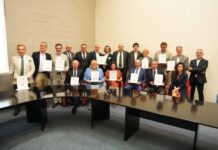
During the presentation, Minister of Culture Alessandro Giuli emphasized that the Kore represents a “living testimony of the spiritual, cultural, and civic ties” between Etruria and ancient Greece, highlighting Vulci as a vital hub of Mediterranean exchange. Experts from the Ministry, the Fondazione Vulci, and partner universities also underscored the extraordinary rarity of the sculpture in Italy and its significance for understanding the interactions between Greek artists and Etruscan patrons during the Late Archaic period.
It was also announced that the Kore head will be exhibited at the new Etruscan Sculpture Museum in Montalto di Castro, set to open before summer at the San Sisto Monumental Complex. Ongoing excavations at the ancient port of Regisvilla alle Murelle, likely the entry point of the sculpture into Vulci, promise to reveal critical insights into the trade and cultural networks that linked the city to the wider Mediterranean.
This remarkable discovery adds a crucial piece to the puzzle of Vulci’s Mediterranean identity and underscores the long-standing dialogue between cultures that shaped the history of the region.