


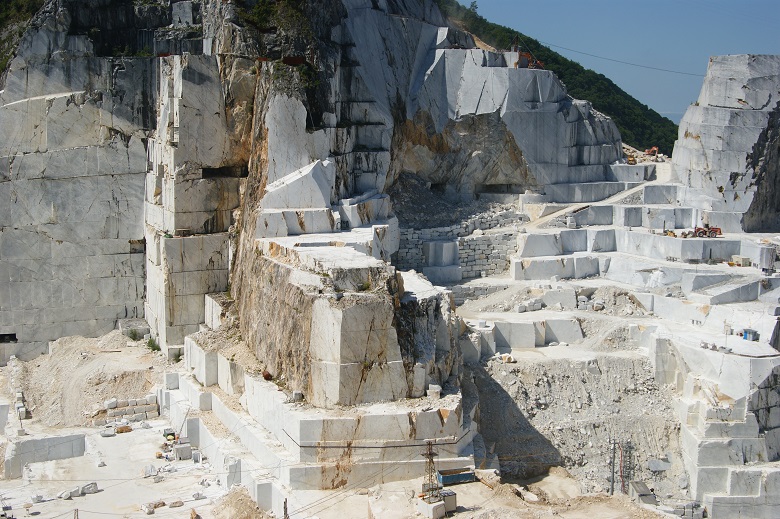



A significant scientific discovery sheds new light on the geological and biological history of our planet. A research team coordinated by the Department of Earth Sciences at the Università di Pisa has identified a new mineral species within cavities of the Apuan marble, opening new perspectives in mineralogical research.
The discovery was made possible thanks to the attentiveness of a quarry manager from the Colonnata marble basin, who provided researchers with a unique specimen. The sample was partly analyzed in the laboratories of the Centro per l’Integrazione della Strumentazione Scientifica dell’Università di Pisa (CISUP), leading to the identification of a completely new mineral: the first copper iodide–methanethiolate ever found in nature.


 A unique mineral
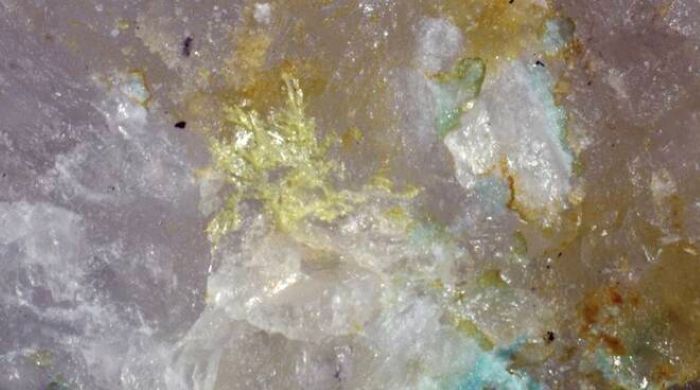
The new mineral, with the chemical formula Cu₃I(CH₃S)₂, has been officially approved by the International Mineralogical Association through its Commission on New Minerals, Nomenclature and Classification. It exists as a single known specimen, currently preserved in the mineralogical collections of the Natural History Museum of the Università di Pisa.
It appears as extremely thin yellow crystals, smaller than one tenth of a millimeter, making its study particularly challenging.
The mineral has been named delchiaroite, in honor of Lorenzo Del Chiaro, a passionate mineralogy enthusiast who significantly contributed to the knowledge of minerals from the Apuan Alps, especially those found in marble cavities.
An extraordinary chemical composition
What makes this discovery exceptional is the unusual chemistry of the mineral. Delchiaroite combines iodine with an organic component (CH₃S), a combination never observed before, either in nature or in laboratory synthesis.
Iodine itself is extremely rare in minerals: out of more than 6,100 known mineral species on Earth, only 31 contain iodine as a chemical constituent. This makes the new mineral even more extraordinary.
A “biosignature” of Earth
The discovery also highlights a peculiar characteristic of Carrara marble: its remarkable enrichment in iodine. Scientists believe this is linked to the presence of organic matter in Jurassic sediments, from which the marble originated after complex geological processes.
In this sense, delchiaroite can be considered a kind of “biosignature.” Only a planet that hosts life can produce minerals with such peculiar chemical compositions. It thus represents evidence of the deep connection between geological and biological evolution on Earth.
New insights into the Apuan Alps
The discovery of delchiaroite confirms the extraordinary geodiversity of the Apuan Alps and provides new insights into the geological evolution of Carrara marble. The study describing this mineral has been published in the European Journal of Mineralogy, highlighting its international scientific relevance.